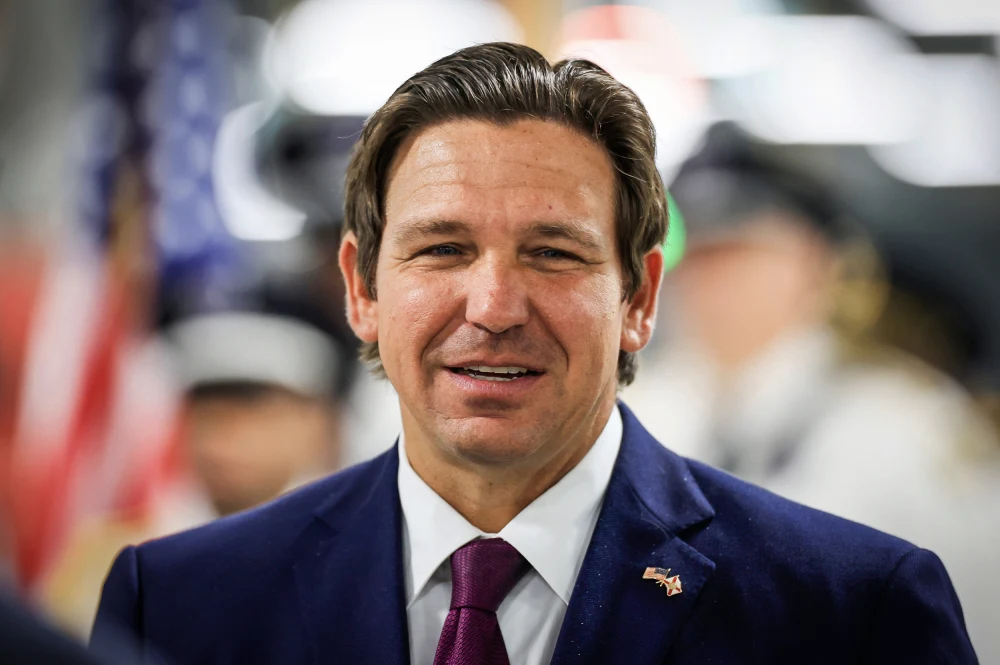
TALLAHASSEE, Fla. — Republicans in Florida have once again rebuffed Gov. Ron DeSantis’ push to pass sweeping AI regulation in the state, a move that comes as he is trying to make himself the face of Republican AI skepticism nationally.
DeSantis was unable to get the Republican majorities in both chambers to pass an AI-focused regulatory scheme during the state’s regular legislative session earlier this year. He again asked them to consider the proposal during a special session that kicked off this week, which is predominantly focused on considering changes to Florida’s congressional lines.
But House Speaker Daniel Perez, a Republican who has a long-running feud with DeSantis, said when opening the special session Tuesday morning that the DeSantis-requested AI proposal would not be considered. That move put Perez on the same side as President Donald Trump, whose administration has said AI regulation should happen at the federal level.
“I understand the governor’s concerns of wanting to protect children,” Perez said. “But we have seen very clearly that the president of the United States issued an executive order stating the federal government should take the handle of the AI policies in this country.”
No Republican in the Florida state House had filed the AI legislation that DeSantis requested, which made it difficult for the measure to be considered during the weeklong special session. The Florida Senate, which is more closely aligned with DeSantis, passed legislation the governor requested on a bipartisan vote, but the issue is moot because the House will not consider the issue.
DeSantis’ office did not return a request seeking comment.
The governor quickly blasted the decision to not consider the AI proposal and a separate one focused on vaccine exemptions for kids.
“Voters elected Republicans to protect freedom against both the Big Tech cartel and the medical industrial complex,” he wrote on social media. “Yet, when given the chance to deliver for their constituents, not a single Republican House member could even be bothered to file a bill.”
The Florida governor in recent months has openly talked about his skepticism of rapid expansion of AI and supported the idea of states implementing their own AI regulations — something opposed by both industry players and the White House.
AI has increasingly become a dominant national political issue, with AI-aligned super PACs flooding the airwaves with ads ahead of the 2026 midterms. Major figures expected to consider a run for president in 2028, including Vice President JD Vance and Secretary of State Marco Rubio, have positioned themselves as clear supporters of the industry and federal — not state — regulation.
DeSantis, himself considered a potential 2028 candidate, has taken the opposite approach. It gives him a political lane on the issue nearly all to himself as jockeying for 2028 positions has already begun.
DeSantis’ expressed skepticism has largely centered on opposition to massive data centers needed to accommodate the industry’s rapid expansion, and the danger AI can pose to children.
“The governor is an AI skeptic because chatbots are convincing children to commit suicide,” Taryn Fenske, a DeSantis political adviser, told NBC News earlier this year.
The governor’s inability to get lawmakers from his own party to pass any sort of AI regulation comes as the industry is expected to have a focus on Florida moving forward.
Earlier this year, NBC News reported that a leading pro-AI super PAC, Leading the Future, is spending $5 million to boost the Republican gubernatorial campaign of Rep. Byron Donalds, who is endorsed by Trump and considered much more friendly to the industry. Donalds was the first state-level candidate to get a financial boost from the group.
Vance, who has led much of the early 2028 public polling, has a background in Silicon Valley venture capital and has close relationships with some of the nation’s biggest tech figures.
He is considered one of the party’s biggest AI champions, and at last year’s Artificial Intelligence Action Summit in Paris, he warned that too much regulation “could kill a transformative industry.”
More recently, though, as polling indicates some voters are concerned about data centers in their backyard and unchecked AI expansion, Vance has struck a tone that speaks to both sides of the debate.
In an interview last fall with Fox News’ Sean Hannity, Vance made the comparison that the rise in AI-related jobs is similar to the arrival of cash-dispensing ATMs.
Vance, unlike DeSantis, has been a proponent of federal regulation.
“I think that eventually you’re going to have some standard applied, whether it’s a federal standard or whether it’s one state standard dominating,” Vance told Fox News last fall. “I think, frankly, the worst possible outcome would be to have far-left California dominate the entire AI regulatory map.”
An NBC News poll conducted in March found that 57% of registered voters are concerned that risks associated with AI outweigh the benefits. It also found that a plurality of voters do not trust either major political party to do a good job of handling the industry’s quick expansion.
Republican pollster Micah Roberts of Public Opinion Strategies, which helped conduct the NBC News poll, said the numbers reflect a real and growing concern that AI’s quick expansion could have huge negative impacts.
“A lot of concerns that people have about this technology negatively impacting jobs and how those are especially relevant to these groups: younger voters [and] women under 50,” he said.