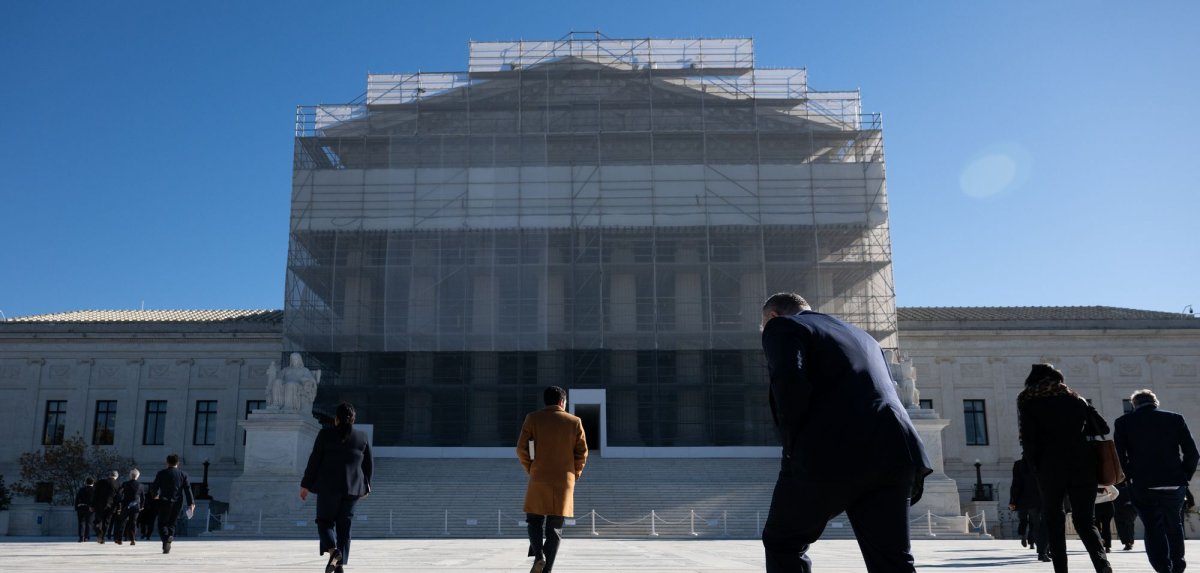
WASHINGTON, Nov. 10 (UPI) — Supreme Court justices appeared skeptical of allowing prisoners to sue government officials for damages in their personal capacities during oral arguments Monday.
The case at hand involves Damon Landor, a devout Rastafarian who vowed never to cut his hair as a part of his faith — a promise known as the Nazarite vow.
Landor was serving a five-month sentence at a Louisiana prison on a drug charge. When he was transferred to a new facility, two guards carried him to a room, handcuffed him to a chair and shaved his hair against his will, according to court filings.
He handed guards an appeals court ruling that shaving a Rastafarian inmate’s dreadlocks violates the Religious Land Use and Institutionalized Persons Act of 2000, or RLUIPA, but the guards threw it in the trash and shaved him, anyway, according to previous testimony.
Landor sued the warden and the guards under the act, which prohibits federally funded state prisons from placing a “substantial burden” on prisoners’ religious exercise.
The law is a sister statute to the Religious Freedom Restoration Act, or RFRA, of 1993. In a 2020 decision, the justices unanimously ruled that the freedom restoration act, which has nearly identical language to the institutionalized persons act, allows people to seek damages against federal prison officials acting in their individual capacities.
The United States filed an amicus brief in support of Landor.
Justice Amy Coney Barrett said the facts of this case “are egregious.” But, she argued, it was unclear there was any precedent for a non-recipient of federal funds to be held individually liable under a federal statute.
Louisiana took the same position. According to the state, the institutionalized persons act functions like a contract between the federal government and the state. Louisiana claimed the warden and guards cannot be sued under the act “because they are not recipients of federal funding.”
All prior federal appeals court rulings have agreed that the act doesn’t authorize damages.
“Every circuit had said there were not damages actions available against non-recipients under RLUIPA,” Barrett said.
The U.S. Court of Appeals for the Fifth Circuit unanimously affirmed the lower court’s decision to dismiss Landor’s claim under Fifth Circuit precedent. Because the act was enacted under Congress’s spending clause, the Fifth Circuit argued “only the grant recipient — the state — may be liable for its violation.”
Lawyers for Landor, however, argue that the law authorizes suits against individuals under the precedent set by the Supreme Court on its sister act.
The two laws “clearly mean the same thing,” according to Zachary Tripp, Landor’s attorney. “The whole point of individual capacity is to have damages … and without damages, officials can literally treat the law like garbage,” he said.
Under causes of action of the institutionalized persons act, a prisoner may obtain “appropriate relief against a government” for violations. The Supreme Court’s conservative majority seemed unconvinced the law was clear enough to authorize suits.
“The hard part, as I see it for your case, for me, is that you need a clear statement,” Justice Brett Kavanaugh said. “And ‘appropriate relief’ is not as clear as it could be in encompassing damages.”
The Supreme Court’s liberal justices seemed more inclined to support Landor’s case. They intensely questioned Jorge Benjamin Aguiñaga, the lawyer for the Louisiana Department of Corrections.
Justice Sonia Sotomayor asked, “You’re saying at the same time that the warden, who is cutting the individual’s hair, should know that that’s a violation of the state, for which an injunction should be liable, but he shouldn’t know that he’s liable for personal damages too?”
Aguiñaga responded, “That’s what 10 federal courts of appeals have said.”
The National Sheriffs’ Association is the only organization to file an amicus curiae brief in support of Louisiana in the case.
Sheriff Greg Champagne, chair of the National Sheriffs’ Association’s legal affairs committee, said that while the facts of the case were “egregious,” a ruling for Landor could enable excessive lawsuits that would strain the prison and court systems.
“We’re concerned about that, kind of opening the floodgates, that it would be expensive, it would be burdensome. … It would burden not only government agencies, it would burden the courts,” he said.
Rastafarian Charles Price, a professor at the University of North Carolina, said employees at state and local prisons are often unaware of prisoners’ religious practices, and the case could place an important check on rights violations.
“If you give incarcerated people the opportunity to sue for individual damages, and they have the evidence for a case, that should have a chilling effect on prison officials misbehaving,” the anthropology professor said.
“I do think it would kind of ratchet up the rights of individuals to protect themselves in instances of abuse.”
The court is expected to decide the case by summer.