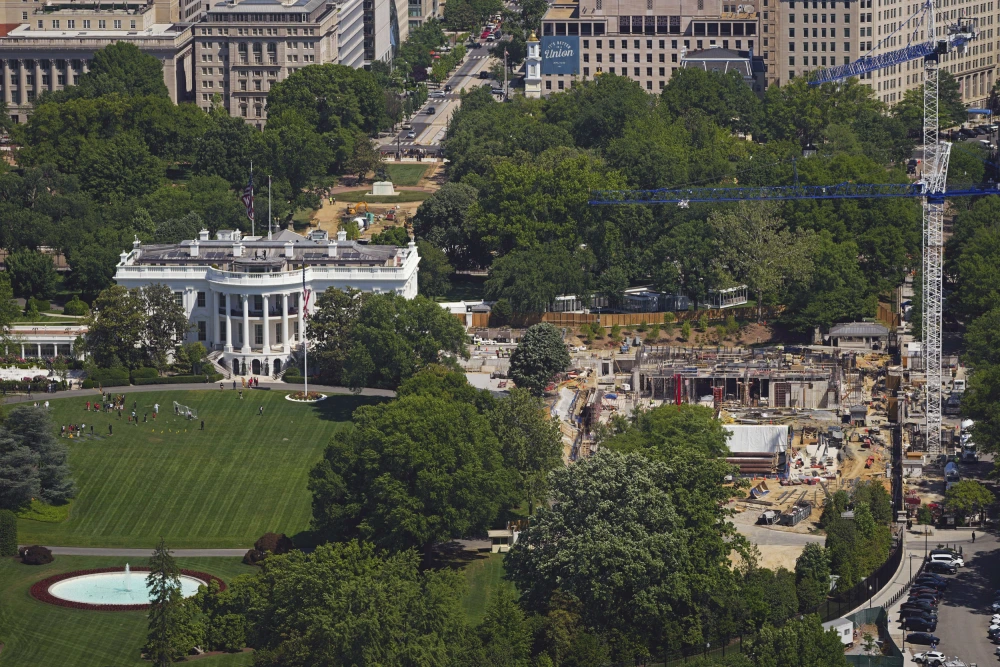
WASHINGTON — After they got a private briefing Tuesday, Senate Republicans remained torn over whether to spend $1 billion in taxpayer funds on President Donald Trump’s ballroom project.
Inside the closed-door lunch meeting, Secret Service Director Sean Curran briefed senators on how the money would be spent.
“He walked through the various categories,” Senate Majority Leader John Thune, R-S.D., told reporters. “So it was a good back-and-forth, a good discussion, and obviously we had a lot of questions that were asked by our colleagues, just to get the details and precision as much as possible about how dollars will be used.”
A memo circulated to senators, obtained by NBC News, provided some of those specifics: $220 million to harden the White House complex, $180 million for a visitors screening facility, $175 million for training and another $175 million to enhance security for Secret Service protectees.
Some GOP senators emerged from the meeting unconvinced or at least wanting more information before they decide.
“I still got some more questions, and they’re going to send us more information,” said Sen. Roger Marshall, R-Kan., usually a reliable vote for Trump. “I’m undecided.”
Sen. John Kennedy, R-La., said he still has “a lot” of questions for the White House about the spending plan. “One of the biggest concerns on our side is adding to the deficit,” he said.
The answers could influence the fate of a broader party-line bill to fund ICE and the Border Patrol, since the ballroom funds are included in what Republican leaders see as a must-pass measure. Democrats forced them to remove money for ICE and Customs and Border Protection from a recent bipartisan appropriations package, vowing not to fund immigration enforcement without policy restraints.
Democrats are making the ballroom funding a focus of their opposition to the current party-line bill, accusing Republicans of taking money from working-class taxpayers to fund a Trump vanity project.
“This ballroom is a disgrace,” Senate Minority Leader Chuck Schumer, D-N.Y., told reporters Tuesday. “The Republicans know it. Let’s see if they have the guts to do what they know is right, both substantively and politically, and tell Trump we don’t need a damn ballroom.”
Democrats, emboldened by polls showing the White House ballroom to be unpopular, plan to force votes on amendments to strip out or redirect the money. Republicans can lose only three votes to protect the provision and pass the bill.
Sen. Rand Paul, R-Ky., has said the project should be carried out with private funds, as Trump initially promised. And three politically vulnerable senators seeking re-election this year are being closely watched: Susan Collins, R-Maine; Dan Sullivan, R-Alaska; and Jon Husted, R-Ohio.
“I don’t have any comment on that until I know all the facts,” Husted said of the ballroom money.
Asked whether he has seen the bill that lays out the funding parameters, Husted said “there are a lot of facts” still to learn. Husted was appointed last year and faces former Sen. Sherrod Brown, D-Ohio, this fall as he eyes his first full six-year term.
Collins told reporters Monday, “My understanding is it’s supposed to be paid for by private donations — that’s what the president has said.” Her office didn’t immediately respond when it was asked after the briefing Tuesday whether she made up her mind.
A spokesperson for Sullivan didn’t immediately reply to a request for comment on his stance regarding the ballroom funding.
A Washington Post-ABC poll taken in late April found 2-to-1 opposition to tearing down the White House East Wing to build a 90,000-square-foot ballroom.
“I think the timing and the optics are really bad,” Sen. Thom Tillis, R-N.C., told reporters Monday. “This time last year, roughly, maybe a little bit before, we were all impressed with the fact that this $400 million building was going to be paid for out of the generosity of donors, and now we’re hearing 2½ times that is necessary for some other aspect of the project.”
Trump has said the ballroom project would cost $400 million and come entirely from private donations. Comcast Corp., the parent company of NBCUniversal, is one of the corporate donors.
Asked whether he would support an amendment to eliminate the ballroom provision, Tillis, who isn’t seeking re-election, said, “I’m going to defer to my colleagues that are in cycle and tough races.”
Sen. Ron Johnson, R-Wis., said Tuesday that “there’s some real security spending in there, which I favor,” although he said the bill “could be” more specific about how to spend the money.
Paul said he’s unsure the provision will survive scrutiny in the “Byrd bath,” in which the Senate parliamentarian strikes provisions that don’t comply with budget rules necessary to end-run the 60-vote filibuster.
“I’m not sure it’s anything we’ll ever vote on, because I think the parliamentarian will make that decision,” he said.
Thune, however, predicted the provision would survive, saying senators are already “making the arguments in front of the parliamentarian” about its validity.
“I’m confident that we will be in good shape, but that process right now is underway,” he told reporters.
If the provision does survive procedurally, Democrats will need at least four Republicans to vote with them to strip it out.
“These ballroom Republicans are choosing Trump’s chandelier over your child care, Trump’s ego over your electric bill, Trump’s palace over the people’s priorities,” Schumer said at his weekly news conference. “Everyone hear that alliteration?”