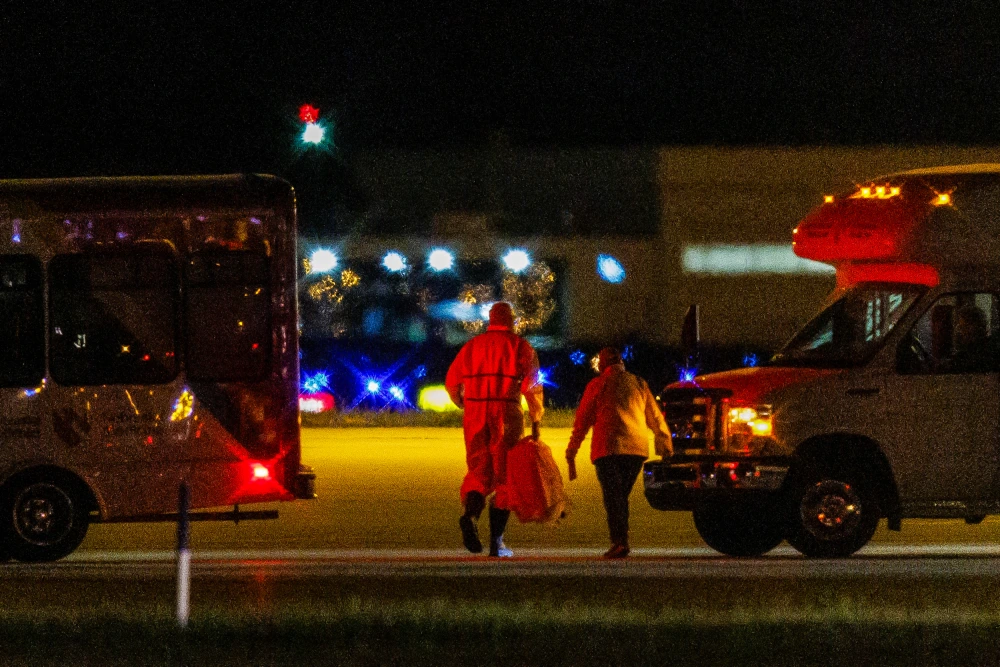
At least six passengers from the MV Hondius cruise ship have tested positive for the Andes strain of hantavirus. Of the 18 Americans who were on board and are now in quarantine facilities in the U.S., at least three are being closely watched for possible infection.
The latest confirmed cases are all among people who had direct contact with other patients who were on the ship, although concerns about how easily — or not — the Andes strain spreads are growing. Andes is the only type of hantavirus that can pass from person to person.
It has been assumed that the virus is contagious only if someone is in close contact with someone who’s having symptoms. Some experts now suggest it’s possible it may be more contagious than thought.
“What we’re hearing now, including from the doctors who were on the ship, is that at least a few people contracted it without that long, prolonged exposure that we’ve always assumed,” Dr. Ashish Jha, a senior fellow at Harvard University’s Kennedy School, told NBC’s “TODAY” show on Monday.
Dr. Brendan Jackson, acting director of the high-consequence pathogens and pathology division at the Centers for Disease Control and Prevention, said in an interview Monday that the close quarters of the cruise ship environment seem to be key in this outbreak.
Cruise ships are notorious for infectious disease outbreaks because they bring together a wide variety of people and stick them in close quarters for days or even weeks — repeatedly sharing high-touch areas like buffets.
“That is definitely different than how we live most of the time,” Jackson said.
Hantavirus is so rare that spread on cruise ships was unheard of until three Hondius passengers were confirmed to have died from the Andes strain this month.
There’s no evidence to suggest the Andes strain has changed to make it more infectious, Jackson said.
While experts maintain that the risk of hantavirus’ spreading widely is extremely low, they say there’s still much to learn about the virus and how it infects people.
How does hantavirus spread from person to person?
Only one of the dozens of hantavirus strains is known to spread among people: the Andes strain. That’s what sickened at least six people who were on the Hondius, and it is suspected in at least two more cases.
The Andes strain doesn’t spread easily, Jackson said. “When it does, it typically involves household members that are doing things like sharing beds or sharing eating utensils or having contact with body fluids,” he said.
Dr. David Fitter, head of the CDC’s Division of Global Migration Health, said at a media briefing Monday at Emory University Hospital in Atlanta, where two passengers are under observation: “This is very different than a respiratory virus. It’s very difficult to spread.”
It’s also possible that the virus can spread between people if they’re physically close to one another for an extended period of time. The CDC tends to define that as being within 6 feet of another person for longer than 15 minutes, Jackson said earlier Monday at a media briefing at the Nebraska Biocontainment Unit in Omaha, where most of the U.S. passengers from the ship were taken for observation.
“There’s nothing magical about 6 feet. It’s not a force field, but it’s a rough number that gives us a sense of how close somebody has been,” he said. “It’s a fairly conservative approach given the evidence we have so far about how this virus has spread in the past.”
Most people with hantavirus, including the Andes strain, become infected after having breathed in or otherwise ingested particles from the urine or droppings from rodents that carry the virus. Just 2% to 5% of all Andes cases are estimated to stem from person-to-person transmission.
Large outbreaks are extremely rare. There was one documented “superspreader” outbreak in Argentina in 2018. Thirty-four people were sickened after several people with hantavirus attended a variety of social events, including a birthday party. Eleven people died.
Can infected people spread hantavirus before they have symptoms?
Jackson said there’s no documented evidence that infected people can spread the virus if they don’t have any symptoms, like coughing or sneezing.
That doesn’t mean asymptomatic spread is impossible.
Dr. Rachael Lee, chief health care epidemiologist at the University of Alabama at Birmingham, said the problem with hantavirus is that patients are identified only when they’re sick enough to be hospitalized. “What we don’t have good data on is how many people are potentially exposed and then just develop antibodies,” Lee said. “We don’t really know too much about transmission from one person to the next.”
Hantavirus is unlike more infectious viruses, like the flu and Covid, because it tends to settle deeper in the lungs, rather than in the upper airways, said Dr. Nicole Iovine, the chief epidemiologist and an infectious disease expert at the University of Florida Health’s Shands Hospital.
“That’s one of the things that would limit the spread of the Andes virus,” she said, “because it’s not in your throat or your nose.”
It’s also why hantavirus can be dangerous, with a fatality rate of up to 50%. The virus can inflame blood vessels, making it difficult for a person to get enough oxygen.
Jackson of the CDC acknowledged that there’s a lot more to learn about hantavirus.
“It’s important to remember that we’re very early in this outbreak,” he told NBC News. “The risk to the public is very, very low at this time, but that doesn’t mean we’re letting our guard down.”