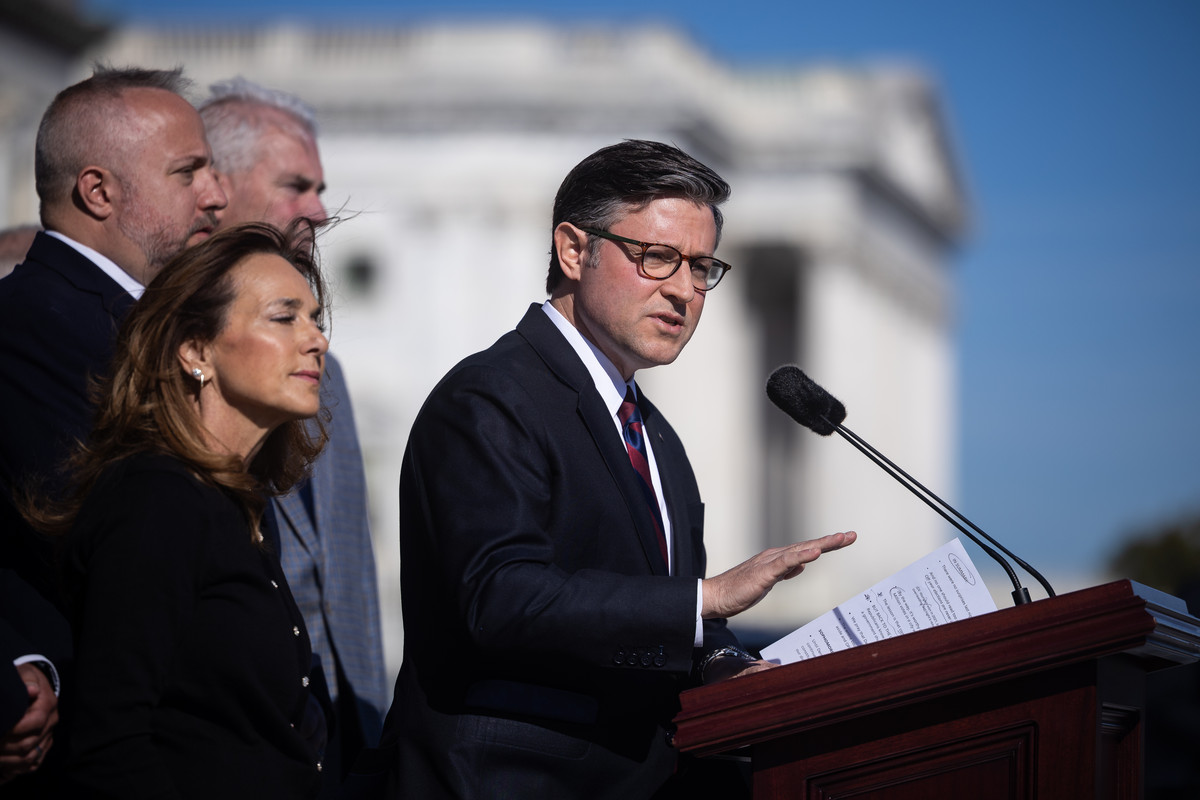
While congressional Republicans have coalesced around a plan to fund immigration enforcement, there are plenty more intraparty battles that will make for rocky legislating for the summer.
At the crux of many of the disputes is anxiety about the looming midterm elections that threaten to erase the GOP’s majority. That’s driving some Republicans to argue they should be as aggressive as possible while they have unified control of power, but it’s causing those in purple districts to worry about backlash from swing voters.
Here are five GOP battles that will drive the House this summer.
Fiscal hawks vs. purple district members
The biggest item on Republicans’ wish list this year is Reconciliation 3.0 — a way to advance partisan priorities through the special budget reconciliation process that bypasses the threat of a Democratic filibuster in the Senate. That mechanism, however, can be used a limited number of times.
The process was used to advance the One Big Beautiful Bill Act of President Trump’s tax cuts last year and is in the process of being used on a “skinny” reconciliation package to fund Immigration and Customs Enforcement and Border Patrol, which Democrats had refused to fund without reforms.
But Speaker Mike Johnson (R-La.) and other Republicans are hoping to use their third and final shot at reconciliation to combine supplemental funding toward the Pentagon for the Iran war with cost-cutting measures that they say will take aim at rooting out fraud in federal programs. Senate Budget Committee Chair Lindsey Graham (R-S.C.) is working with House Budget Committee Chair Jodey Arrington (R-Texas), a major fiscal hawk, to craft such a proposal.
Moving such a big package through the narrow majority, though, is a tall order as swing-district Republicans see risks in pursuing big spending cuts as they aim to woo voters — leading to pessimism that such a package will get across the finish line.
Privacy hawks vs. Intel Republicans
Battles over reforms to the nation’s spy powers that have been brewing for months are far from settled and are set to come up again in the coming weeks.
Privacy hawks defied GOP leaders and the White House by preventing an 18-month “clean” extension of Section 702 of the Foreign Intelligence Surveillance Act (FISA), which authorizes the government to surveil foreign targets on foreign soil.
Those privacy hawks are demanding more reforms to prevent any Americans’ communications swept up in the surveillance from being accessed without a warrant. Intel-minded Republicans, meanwhile, say such a requirement would tie the hands of law enforcement.
The House in April passed a package with some modest reforms while extending the authorization for three years — while tacking on an unrelated measure to ban the Federal Reserve from creating a central bank digital currency (CBDC), another measure of concern to privacy hawks.
Senate Republican Leader John Thune (S.D.) has said the CBDC measure is “dead on arrival” in the upper chamber, and Congress passed a 45-day extension as the Senate grapples with the House package and is likely to return it to the lower chamber with changes.
That means more chances for the privacy hawks to demand changes before the FISA authorization expires June 12.
MAHA vs. deregulation advocates
For decades, the Republican Party has built its brand around a pro-business agenda that’s largely rejected government regulations — particularly those related to environmental protection — that might hurt corporate bottom lines. The arrival of the Make America Healthy Again (MAHA) movement, however, is challenging those conventions, as a small but powerful group of populist Republicans — influencers and lawmakers alike — press for tougher rules on corporations and their toxic products in the name of protecting public health.
Trump won the favor of many in the healthy living movement when he tapped Robert F. Kennedy Jr., a MAHA standard-bearer, to lead his Health and Human Services Department.
The clash has turned the politics of deregulation on its head, aligning conservative MAHA activists and liberal environmentalists, who want tougher rules, against traditional, pro-business Republicans who are warning of the economic harm of government encroachment on free markets.
That squabble was front and center during the recent farm bill debate in the House, where Rep. Anna Paulina Luna (R-Fla.) and other MAHA-friendly Republicans pushed hard to amend the initial package by removing a provision that would have shielded pesticide makers from lawsuits related to the labeling of their products. Writing in The Wall Street Journal, conservative columnist Kimberley Strassel attacked Luna for exhibiting an “ideological confusion” that abandons the “foundational principles” of conservatism.
“When you reject federalism, free markets and choice you end up with … Democrats,” Strassel wrote.
The House approved Luna’s amendment, greasing the path to passage in the lower chamber. But there are already rumblings that pro-business Republicans in the Senate will strip it out to protect the pesticide makers. That would infuriate the MAHA group in the House — and set the stage for yet another tense battle over the fate of the farm bill later in the year.
“To the Senate: don’t,” Luna warned in a post on social platform X. “If this comes back with those protections included, we have the votes to kill it.”
Corn-state vs. oil-state Republicans
A vote long sought by corn-state Republicans to codify year-round sales of E15, a fuel blend with 15 percent ethanol and 85 percent gasoline, complicated the passage of the farm bill in April — and could bubble up again soon.
Sales of E15 have been typically restricted for parts of the year because of smog concerns, though Trump has used executive action to allow E15 sales this summer.
House Republican leaders had initially tied a year-round E15 bill to the farm bill, but Republicans from oil-producing states had concerns about the E15 bill and refused to allow GOP priorities to move forward, citing concerns about how the legislation would affect small refineries in particular.
While a compromise decoupled the E15 bill from the farm bill, it is still expected to come up for a vote in the House as soon as this week — with E15 advocates hoping it will put pressure on the Senate to pass it too.
Two prominent House Freedom Caucus members pushed back at E15 advocates in an op-ed for The Hill this week.
“Proponents of a fuel blend containing 15 percent ethanol year-round pitch its sales as a form of deregulation and consumer choice. In truth, ‘E15,’ as it is known, is the ethanol lobby’s Trojan horse to expand one of the most costly and destructive federal mandates in U.S. history: the Renewable Fuel Standard,” Reps. Scott Perry (R-Pa.) and Chip Roy (R-Texas) wrote.
Iran skeptics vs. hawks
Trump’s extraordinary political rise a decade ago was partially attributed to his attacks on “forever wars” in the Middle East — and a promise not to entangle the United States in more military adventures overseas.
The Iran war has defied that promise, and it’s splintered the MAGA faithful into starkly opposing camps, pitting those defending the conflict in the name of national security against others accusing the president of abandoning his commitment to “America First.”
Much of that fight is happening outside of the Beltway, where conservative pundits who were once united behind Trump are now clashing over the wisdom and justification of the attacks on Tehran. Some of the detractors, like former Rep. Marjorie Taylor Greene (R-Ga.) and Tucker Carlson, have abandoned Trump altogether and apologized for ever supporting him.
On Capitol Hill, the divisions are hardly as dramatic. But there are disagreements within the GOP over how much power Trump should have to continue the fight against Tehran. And the list of concerned voices is growing as the cost of gas has spiked, top Trump officials have struggled to define an exit strategy, and the conflict passed the 60-day mark — a key deadline under the War Powers Act of 1973.
Rep. Brian Fitzpatrick (R-Pa.) has introduced a war powers resolution designed to end the conflict until Trump can win Congress’s explicit approval. And this week, GOP Rep. Tom Barrett (Mich.), an Army veteran, unveiled a separate resolution, known as an Authorization for Use of Military Force, which would empower Trump to continue the fight under certain strict limits in scope, but also require the operations to cease at the end of July.
It’s unclear if any of the efforts to rein in Trump’s use of military force have the support to pass through Congress. Previous war powers resolutions have repeatedly been blocked by Trump’s GOP allies in both the House and Senate.
But the growing appetite among Republicans to do something to end the conflict will be a continuing headache for Johnson and other GOP leaders, who have deferred to Trump throughout the war.