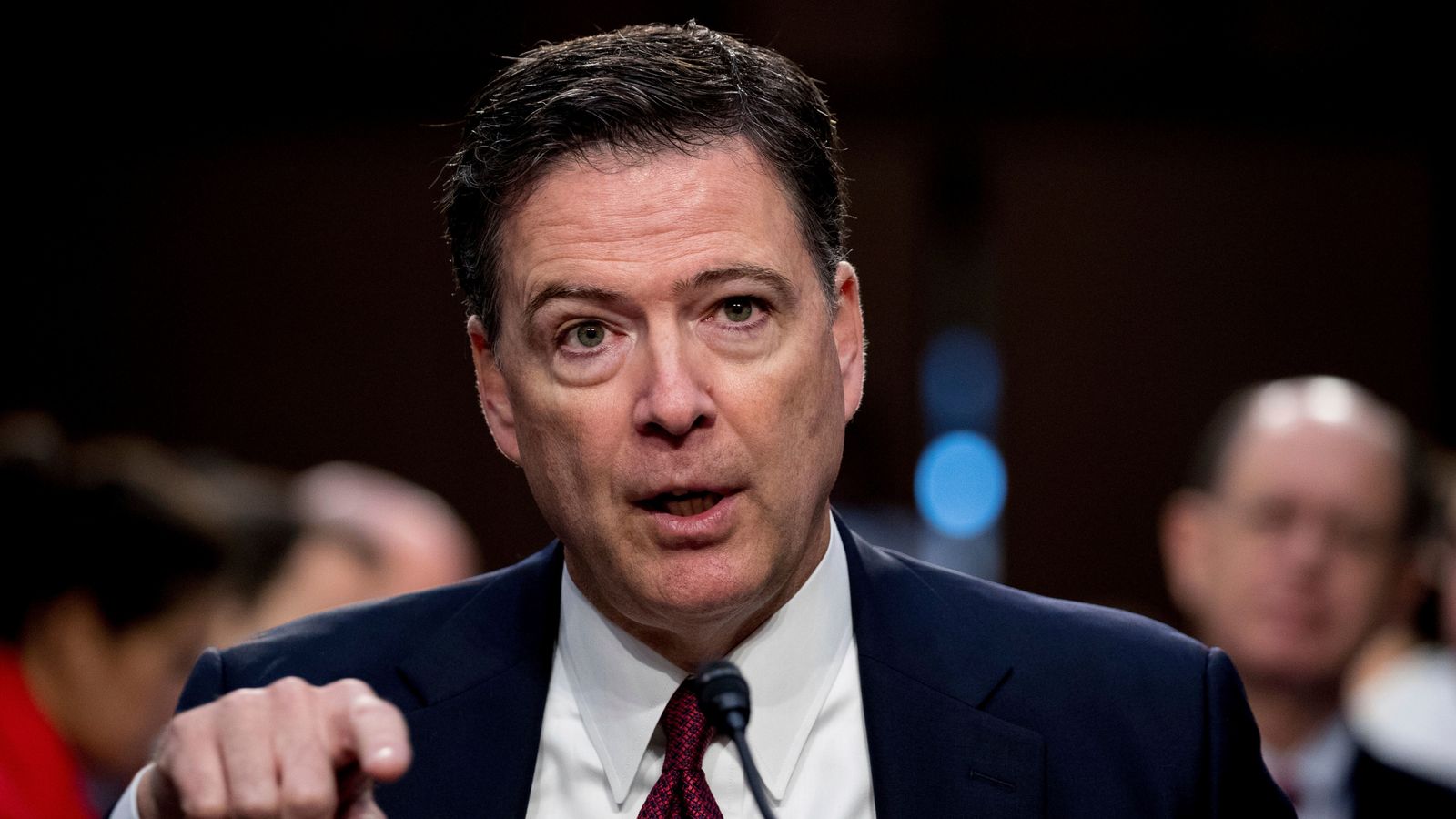
The Justice Department secured an indictment Tuesday charging former FBI Director James Comey with threatening the life of President Donald Trump by posting a photo of seashells on Instagram.
The two-count indictment, posted Tuesday afternoon, alleges that a reasonable person would interpret the image of the shells, arranged to spell out “86 47,” as “a serious expression of an intent to do harm to the President of the United States.”
Justice Department attorneys sought the indictment in the Eastern District of North Carolina, where Comey has a beach house and where he posted the beach scene photo. The Department of Homeland Security previously investigated Comey, who has long been a Trump target, over the May Instagram post, even subjecting him to questioning by the Secret Service.
Comey had deleted the post, saying it never occurred to him that it would be interpreted as being violent. “Eighty-six” is a term commonly used in restaurants when an item is sold out, and it’s also informally used to mean “cancel” or “get rid of.”
In a subsequent Instagram post in May, Comey said that he assumed the shells he saw on a beach walk were “a political message” and that he “didn’t realize some folks associate those numbers with violence,” adding that he opposed violence “of any kind.”
Comey said in a video posted after his indictment that he was innocent, that he was not afraid and that he still believed in the independent judiciary.
“They’re back,” he said of the Trump administration. “This time about a picture of seashells on a North Carolina beach a year ago. And this won’t be the end of it.”
Comey said it was very important to remember that “this is not who we are as a country, this is not how the Department of Justice is supposed to be.”
Patrick Fitzgerald, an attorney for Comey, said in a statement that his client “vigorously denies the charges contained in the Indictment filed in the Eastern District of North Carolina.”
“We will contest these charges in the courtroom and look forward to vindicating Mr. Comey and the First Amendment,” Fitzgerald added.
The White House referred all questions about the matter to the Justice Department.
At a news conference Tuesday, acting Attorney General Todd Blanche did not offer any evidence that Comey “knowingly and willfully” made a threat, which is a core component of the charges. Pressed by NBC News about how federal prosecutors could prove Comey’s intent, Blanche said there had been a “tremendous amount of investigation” and that, in general, the Justice Department proves intent with witnesses and documents and potentially by examining the witness.
Blanche added that it was “very premature” to discuss whether Comey would choose to testify at a theoretical trial.
“I am not going to talk about the evidence that we have. That’s unfair to him. It’s unfair to the prosecutors,” Blanche said.
Two senior law enforcement officials said Tuesday that despite an arrest warrant being issued in the case, discussions are ongoing between the Justice Department and Comey’s attorneys and that the expectation is that Comey will turn himself in to federal authorities in North Carolina later this week.
Blanche referenced those discussions at the news conference but did not elaborate on them.
The two law enforcement officials said don’t expect to see Comey in handcuffs, and no law enforcement personnel have been told to prepare for an arrest.
Trump administration officials quickly rallied to condemn Comey over the post in May, with then-Homeland Security Secretary Kristi Noem boasting that Secret Service agents interviewed the man she called the “disgraced” former FBI director, while National Intelligence Director Tulsi Gabbard said Comey should be “put behind bars for this.”
The Trump administration previously indicted Comey on charges alleging he lied to Congress five years ago, in a case that was dismissed after a judge ruled that the prosecutor behind the original case, a former lawyer for Trump, had been unlawfully appointed.
Comey was first indicted in September on charges of making a false statement to Congress and obstructing a congressional investigation. The Justice Department charged him just days before the statute of limitations expired. The case centered on Comey’s testimony to Congress in 2020 that he stood by his congressional testimony in 2017, when he said he did not authorize any third party to speak to the media about an FBI investigation.
A judge dismissed the first case against Comey, as well as one against New York Attorney General Letitia James, citing the “unlawful” Trump appointment of Lindsey Halligan as the interim U.S. attorney for the Eastern District of Virginia. Halligan was the sole prosecutor to sign the Comey and James indictments, a departure from most federal indictments.
The indictment of Comey in that case did not include an arrest warrant.
Blanche said Tuesday that the grand jury, not the DOJ, issued an arrest warrant in the new case against Comey. In some rare instances, grand juries have the authority to issue arrest warrants.
Typically, grand juries issue indictments which then lead to an arrest warrant. Usually, its prosecutors or police who request the arrest warrant, if needed, from a judge or through the clerk’s office.
There was an unsealed request for a warrant on the docket Tuesday from the U.S. attorney to the federal court clerk. It does not say it’s at the request of the grand jury, and the warrant itself is not visible on the docket.
Prosecutors face only a low probable cause standard when they try to secure an indictment from a federal grand jury, not a unanimous guilty verdict that a defendant committed a crime beyond any reasonable doubt, as required at trial.
Trump had publicly urged then-Attorney General Pam Bondi to take legal action against Comey, as well as James. Trump soured on Comey, a lifelong Republican, shortly after he took office in 2017. He fired him in May 2017, which sparked the appointment of special counsel Robert Mueller to investigate Russian interference in the 2016 election, a probe that routinely drew Trump’s ire.