Evidence continues to mount that the U.S. was responsible for the deadly school strike in southern Iran that killed scores of children as images taken near the school have emerged showing fragments of American-made missiles.
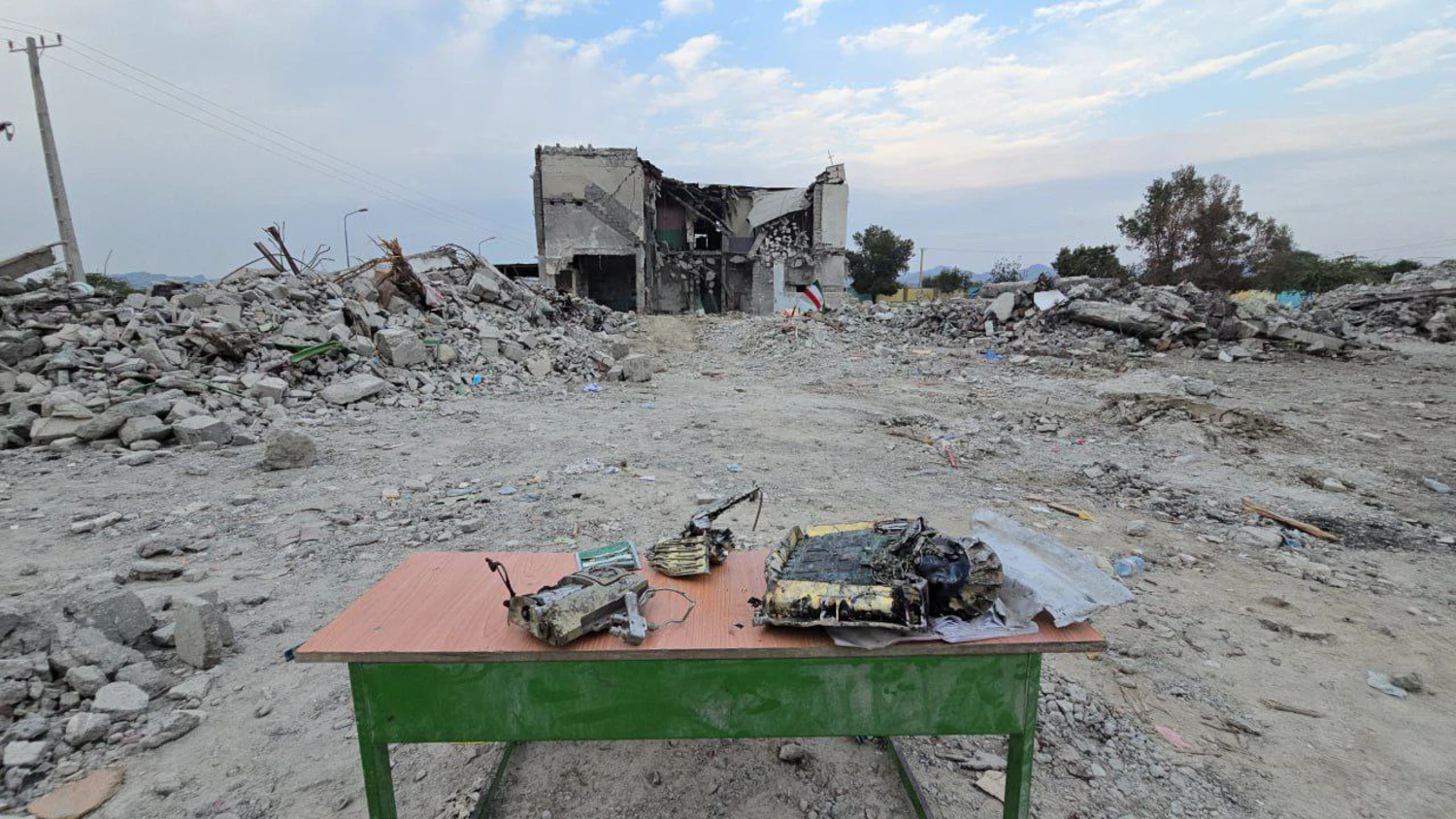
The missile fragments purported by Iranian state media to have struck the school bear the markings of an American Tomahawk missile, according to experts who reviewed imagery obtained by NBC News and others, shared by state media, that appeared to show the fragments on a table close to the scene.
The videos obtained by NBC News appeared to show close-ups of the same set of missile fragments. They could not be geolocated as a result, whereas other wide-shot imagery shared by state media appeared to align with previously confirmed video and satellite imagery of the school site. Meanwhile, voices heard in video obtained by NBC News appeared to reflect a southern accent consistent with Minab.
NBC News could not independently confirm where, when or how the missile fragments were found or whether they were connected to the school strike. It was also unclear exactly who recovered them.
More than 170 people, including many children, were killed in the Feb. 28 strikes on the school in Minab, according to Iranian officials.
President Donald Trump issued his latest suggestion of Iranian involvement in the attack hours after the emergence of a video, geolocated by NBC News, that appears to show a U.S. Tomahawk striking an Islamic Revolutionary Guard Corps site near the school.
Asked by a reporter Monday why he was the only U.S. official suggesting that Iran was responsible, Trump said, “Because I just don’t know enough about it.”
“I think it’s something that I was told is under investigation, but Tomahawks are, are used by others,” he said.
Appearing to refer to the incident, Defense Secretary Pete Hegseth said Tuesday that the U.S. would investigate “where things happen that need to be investigated.” He added that “open source” was “not the place to determine what did or did not happen.”
“We take things very, very seriously and investigate them thoroughly, which takes time,” he said.
Asked about the images released on Iranian state media, the Defense Department pointed to its ongoing investigation.
Trump said Monday that he would be “willing to live with” the results of the probe examining who was responsible for the attack and how it happened.
But he insisted that another party could be responsible, claiming Iran itself “also has Tomahawks,” even though the U.S., the United Kingdom and Australia are the only countries known to have them, with Japan and the Netherlands also having agreed to purchase them in recent years.
The Pentagon has acknowledged using Tomahawk missiles in the war, publishing a photo and video online of the USS Spruance firing a Tomahawk land attack missile on Feb. 28, the day the U.S. launched strikes on Iran, as well as the day the school was struck. It was not clear what area the strike that hit the school might have been targeting.
Meanwhile, Trump administration officials told members of Congress at a closed-door meeting last week that the U.S. had been targeting the area where the school was struck, two U.S. officials told NBC News.
The administration officials also said their military partner, Israel, was not responsible for the school’s bombing, the two U.S. officials said, with the Israeli military saying it is not aware of any connection between its operations in Iran and the school strike.
The Trump administration’s preliminary findings show it is increasingly likely that a U.S. munition was used, according to a U.S. official and a person familiar with the investigation. The U.S. is still looking into whether the strikes were the result of bad intelligence or poor targeting, the sources said.
Weapons experts were confident that the images of missile fragments obtained by NBC News and those published by Iranian state media did appear to show an American Tomahawk cruise missile, though NBC News cannot verify where the fragments were found or whether they were connected to the school strikes.
“The components indicate this is a Tomahawk cruise missile,” said Sam Lair, a research associate at the James Martin Center for Nonproliferation Studies.
He said the circuit boards manufactured by Raytheon suggested a Tomahawk missile, given that Raytheon is the lead manufacturer for the Tomahawk Land Attack Missile, while the Globe Motors component seen in one of the images is “likely an actuator for the control surfaces of the missile,” including its fins. Raytheon’s parent company, RTX Corp., announced just last month that the branch had entered into five “landmark framework agreements” with the Defense Department to “significantly increase production capacity and speed deliveries” of Land Attack and Maritime Strike variants of Tomahawk missiles, among others.
Lair further said the Ball Aerospace component seen in a separate image appeared to be the cover for a satellite data link antenna, which has been incorporated as part of a communications system installed in more modern versions of the Tomahawk. A number on the component appears to align with a Defense Department contract, suggesting the part was supplied to the U.S. military under a 2014 order.
“Those debris do appear consistent with the BGM-109 Tomahawk line of American cruise missiles,” said Justin Bronk, a senior research fellow for airpower and technology in the military sciences at the Royal United Services Institute, a think tank based in London.
“The strike footage also clearly shows a cruise missile, and the shape is consistent with Tomahawk rather than other types that may have been in use during the campaign, like the air-launched JASSM,” he told NBC News on Tuesday, referring to a Joint Air-to-Surface Standoff Missile used by the U.S. Army.
Retired U.S. Army Lt. Col. Daniel Davis, a Bronze Star recipient who served for 21 years, emphasized that without being able to independently confirm exactly where the fragments were found and when, it is difficult to draw any definitive conclusions from the debris.
“By itself, that doesn’t really — it just doesn’t say anything,” he said. However, he said, it felt unlikely that Iran was responsible.
“I just don’t see evidence of that,” said Davis, now a senior fellow and military expert at Defense Priorities, a Washington-based think tank, adding that it “doesn’t really pass the commonsense test.”
“Unless you think they got them on the black market, and then that would mean that they got them from one of our allies somewhere,” he said. Meanwhile, he said, even if that hypothetically were the case, “if you don’t have the means to fire it, then it’s meaningless. It’s just a paperweight.”