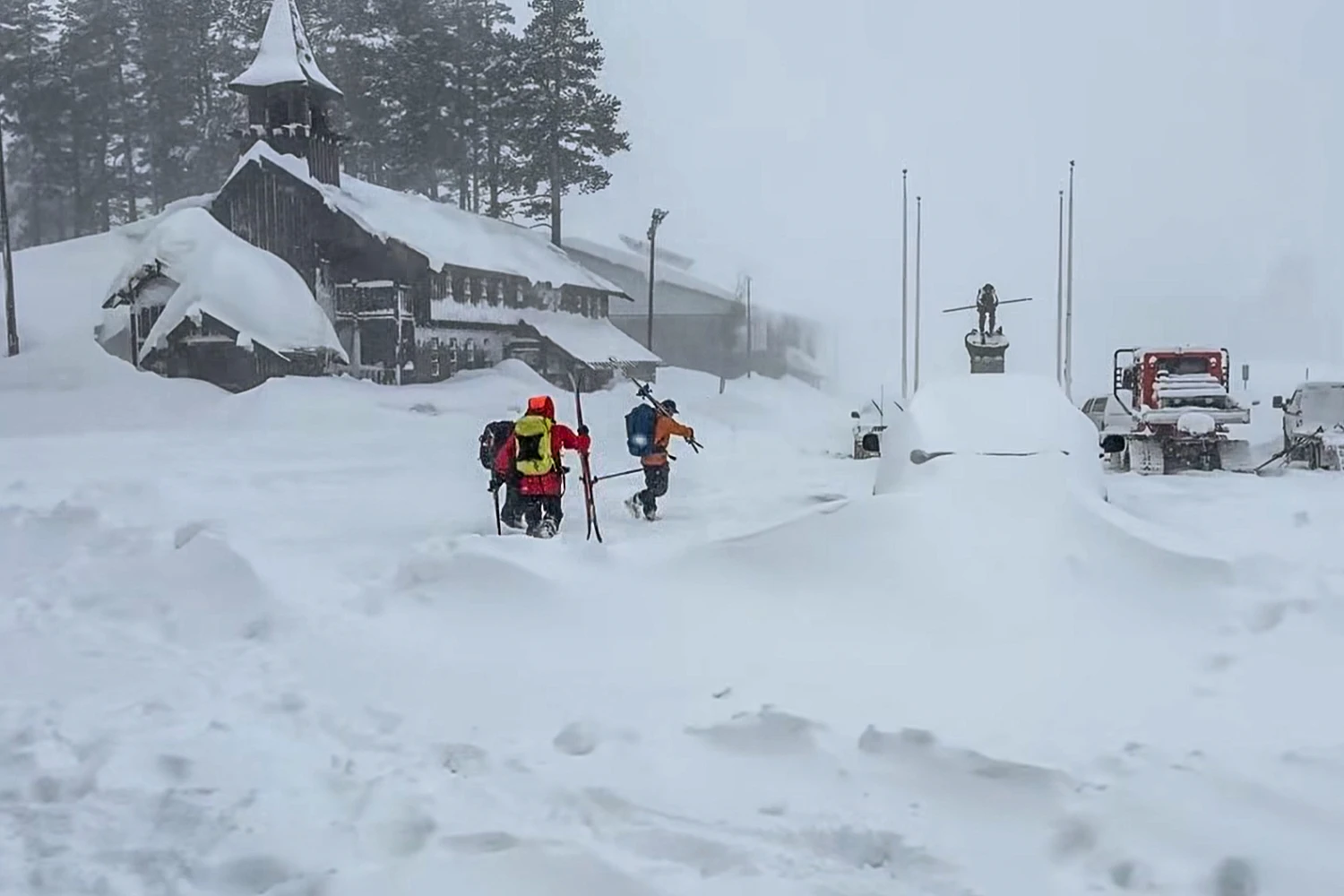
Six skiers were rescued, but nine remained missing after an avalanche Tuesday near the town of Truckee, California, authorities said.
The avalanche happened in the area of Castle Peak, a popular backcountry ski destination northwest of Lake Tahoe, the Nevada County Sheriff’s Office said in a news release.
The sheriff’s office said the six people who survived the avalanche were rescued by a team who navigated treacherous conditions for several hours to reach them.
“Two of the six skiers have been transported to a hospital for treatment. The search is ongoing, pending weather conditions,” Ashley Quadros, a Nevada County Sheriff’s Office spokeswoman, said in a news release at 10:40 p.m. local time.
The sheriff’s office initially said the group caught up in the slide included 16 people but clarified Tuesday night that it was a group of 15.
Russell Greene, a captain with the sheriff’s office, said in an interview Tuesday evening that a mountain guide service reported the avalanche about 11:30 a.m. and that it was also reported, separately, through an emergency beacon device.
Around 46 rescuers were traveling to the site, Greene said Tuesday evening.
In a statement Tuesday night, Blackbird Mountain Guides, which offers guided backcountry tours, said the group caught up in the avalanche included clients and guides.
“The group was in the process of returning to the trailhead at the conclusion of a three-day trip when the incident occurred,” it said.
The group had been staying at Frog Lake Backcountry Huts since Sunday, the company said. Frog Lake Backcountry Huts provides sleeping accommodations “set on the edge of an alpine lake nestled in pristine forest,” it says on its website.
Blackbird Mountain Guides said it was working with the sheriff’s office and a search-and-rescue agency in Nevada County “to support the ongoing rescue operation.”
The sheriff’s office was in touch with the surviving skiers through an emergency satellite messaging service, which was allowing them to send text messages, Greene said earlier.
“It’s in a tough area. It’s just going to be slow going so we don’t trigger any other avalanches, because that is definitely a possibility,” he said, adding that the risk of additional slides was significant enough that “we’re hesitant to send anybody in on a snowmobile.”
Greene said the six survivors had taken shelter in a treed area near the site.
“They have at least a tarp with them, so they’re doing their best to create somewhat of a structure and get out of the elements as best they can, and we will begin treating and dealing with that when we get there,” Greene said.
The weather in Truckee — a town of about 17,000 people close to Lake Tahoe and California’s eastern border with Nevada — has been treacherous, with blizzard conditions impeding search-and-rescue efforts.
The Boreal Mountain Ski Resort, which is near Castle Peak, reported about 30 inches of snow over the past 24 hours.
The National Weather Service said 3 to 4 inches of snow were falling per hour in some areas of the Sierras near the incident.
“Plan on hazardous road conditions, poor visibility due to falling and blowing snow, and even periods of white out conditions in locally heavy snow through late tonight,” forecasters wrote Tuesday afternoon. “Travel is highly discouraged in the Sierra as periods of whiteout conditions are likely.”
Interstate 80 closed Tuesday, with the California Highway Patrol reporting whiteout conditions and near-zero visibility.
“It obviously hampered our response,” Greene said.
An avalanche warning was in effect for the Tahoe region Tuesday because of the heavy snow.
“HIGH avalanche danger exists in the backcountry. Large avalanches are expected to occur Tuesday, Tuesday night, and into at least early Wednesday morning across backcountry terrain,” the Sierra Avalanche Center wrote in a bulletin issued Tuesday, before the avalanche was reported. “Natural avalanches are likely, and human-triggered avalanches large enough to bury or injure people are very likely.”
The forecasting center said avalanches up to D3 in size were likely— meaning slides powerful enough to bury a car or house were a concern.
Forecasters were concerned about the possibility of what’s known as a storm slab avalanche because the intense snowfall was creating a heavy layer of accumulated snow that was resting on a weak, sugary layer of snow that had remained during a recent dry spell.
Forecasters noted particular concern on more shaded north-facing slopes, where a weak layer had been observed. The forecasters also said “natural” avalanches were expected, meaning avalanches could release on their own and without a human trigger – like the weight of skiers – on the snowpack.
“Avalanches could be triggered from very low on the slope in some areas,” forecasters wrote. “If attempting travel today in non-avalanche terrain, be certain that there are no steeper slopes connected to the terrain you are traveling, either above or to the side.”
In an initial report, the avalanche forecasting center said Tuesday’s slide had taken place on a north-facing aspect at around 8,200 feet elevation, below a feature called Perry’s Point. The location is about a half mile from the Frog Lake Backcountry Huts and about 2.5 miles from a trailhead along I-80.
Avalanches typically occur in terrain that has a slope angle between 30 and 45 degrees, with roughly 38 degrees considered a sweet spot. Terrain below 25 degrees is typically not steep enough to slide.
The incident location provided by the avalanche center is in low-angle terrain, which would have been safer to travel in during high-risk conditions. However, higher angle terrain loomed above the point provided by the avalanche center, according to topographic maps.
Backcountry skiers typically carry safety gear, including avalanche beacons, shovels and probes, to help with companion rescue in the event of an avalanche. Avalanche beacons, or transceivers, have two modes: one in which a signal is sent to help rescuers identify a victim’s location and another that searches for those signals.
In avalanche rescue events, rescuers carrying transceivers will search for the signals of those buried beneath the snow. They will also use avalanche probes — typically long aluminum poles held together with taut cables — to poke into the snow to try to locate a buried victim.
Avalanche victims can suffer physical trauma — broken bones and torn ligaments — when they are carried in a slide. The biggest risk is suffocation in a prolonged burial longer than 15 to 20 minutes.
Over the past 10 years, the U.S. had an average of 27 avalanche deaths each year, according to the Colorado Avalanche Information Center.