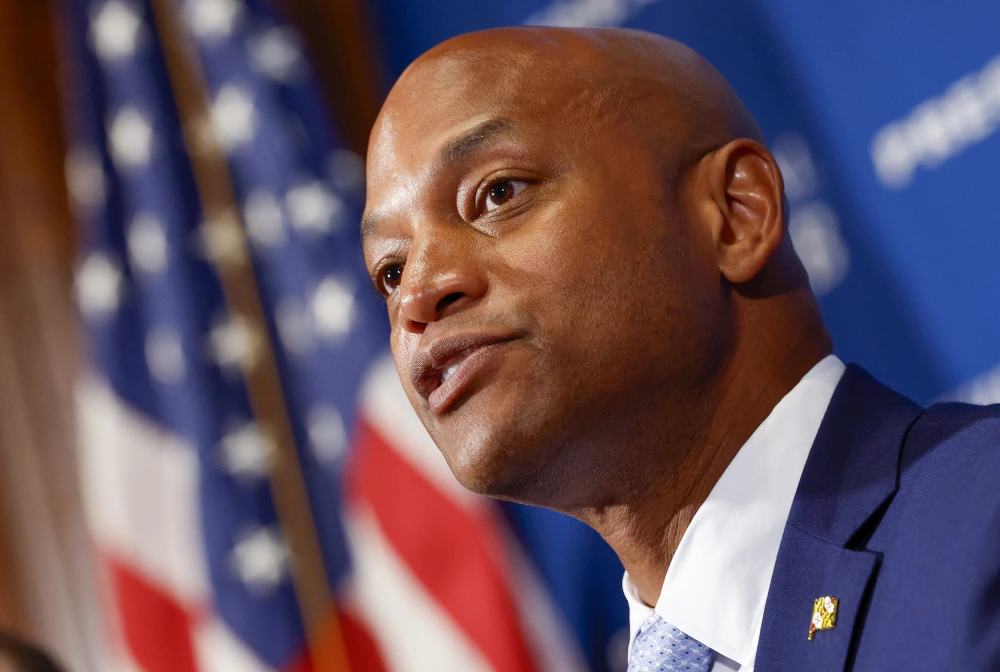
A redistricting commission formed by Maryland Gov. Wes Moore voted to recommend a new congressional map that would draw the state’s lone Republican, Rep. Andy Harris, into a more Democratic-friendly district.
The map now heads to Maryland’s Democratic-controlled Legislature, where its future is uncertain because of continued opposition in the state Senate.
Maryland Democrats have been split on whether to join the national mid-decade redistricting fight. Moore and national Democrats have urged state lawmakers to retaliate against GOP-controlled states that drew new maps last year, and the state’s new House speaker, Joseline Peña-Melnyk, is on board, too.
But Maryland Senate President Bill Ferguson has repeatedly said the Democratic caucus won’t back a redrawn map, arguing that it would be legally risky and could backfire politically.
Ferguson sharply criticized the commission’s map proposal Tuesday.
“The Governor’s Commission recommended a map today that is objectively unconstitutional and jeopardizes Maryland’s existing map,” Ferguson said in a statement. “From the outset, the Senate’s position has been consistent: in this important moment, Maryland cannot risk going backwards by giving the Trump Administration another seat or two in Congress from Maryland’s delegation.”
The Maryland Legislature would need to pass a new map quickly to have it in place for this year’s midterms elections, where control of the House is up for grabs. The state’s congressional filing deadline is Feb. 24 and the primary is June 23, though lawmakers could vote to move back both dates.
The possibility of a constitutional amendment on redistricting is also being discussed, which would put the issue before voters, a source with knowledge of the negotiations said.
House Minority Leader Hakeem Jeffries, D-N.Y., applauded the commission’s proposed map.
“Partisan Republican hacks were counting on Democrats to roll over while they gerrymander congressional maps in Texas, Missouri, North Carolina and Florida. They were wrong,” he said in a statement. “Arrogant and corrupt Republicans started this battle. Democrats will end it. We will ensure that there is a free and fair midterm election in November.”
The redistricting commission, which is chaired by U.S. Sen. Angela Alsobrooks, D-Md., hosted a half-dozen virtual hearings in the last three months, allowing voters to submit maps and testify publicly on redistricting.
“At a moment when other states are moving aggressively to redraw maps, and when fundamental voting rights protections face renewed threats, Maryland has a responsibility to lead with urgency,” Alsobrooks said in a statement.
Moore touted the process as the most “expansive” in the nation in an interview with The Associated Press, though Ferguson criticized the commission for hosting private meetings.
Ferguson argued Tuesday that there was little testimony on how the new map would affect elections.
“Ultimately, a flawed process has delivered a flawed product,” Ferguson said in his statement.
State Sen. Clarence Lam, a Democrat who supports the redistricting push, said he thought the release of a map would mobilize voters in support.
“What happens in D.C. is incredibly important to Marylanders’ quality of life and pocketbook,” said Lam. “We have to make that case to Marylanders to help them understand why even one seat can make a difference.”
“The next week or two are going to be critical,” he added.
The redrawing of district lines typically happens at the start of each decade after the new census results. But President Donald Trump kicked off an unusually frenzied mid-cycle redistricting campaign last summer, when he called on Republican-controlled states across the country to draw new maps to shore up the GOP’s narrow House majority.
In total, six states enacted new congressional maps in 2025, while Virginia Democrats and Florida Republicans are taking steps to join the fray this year.