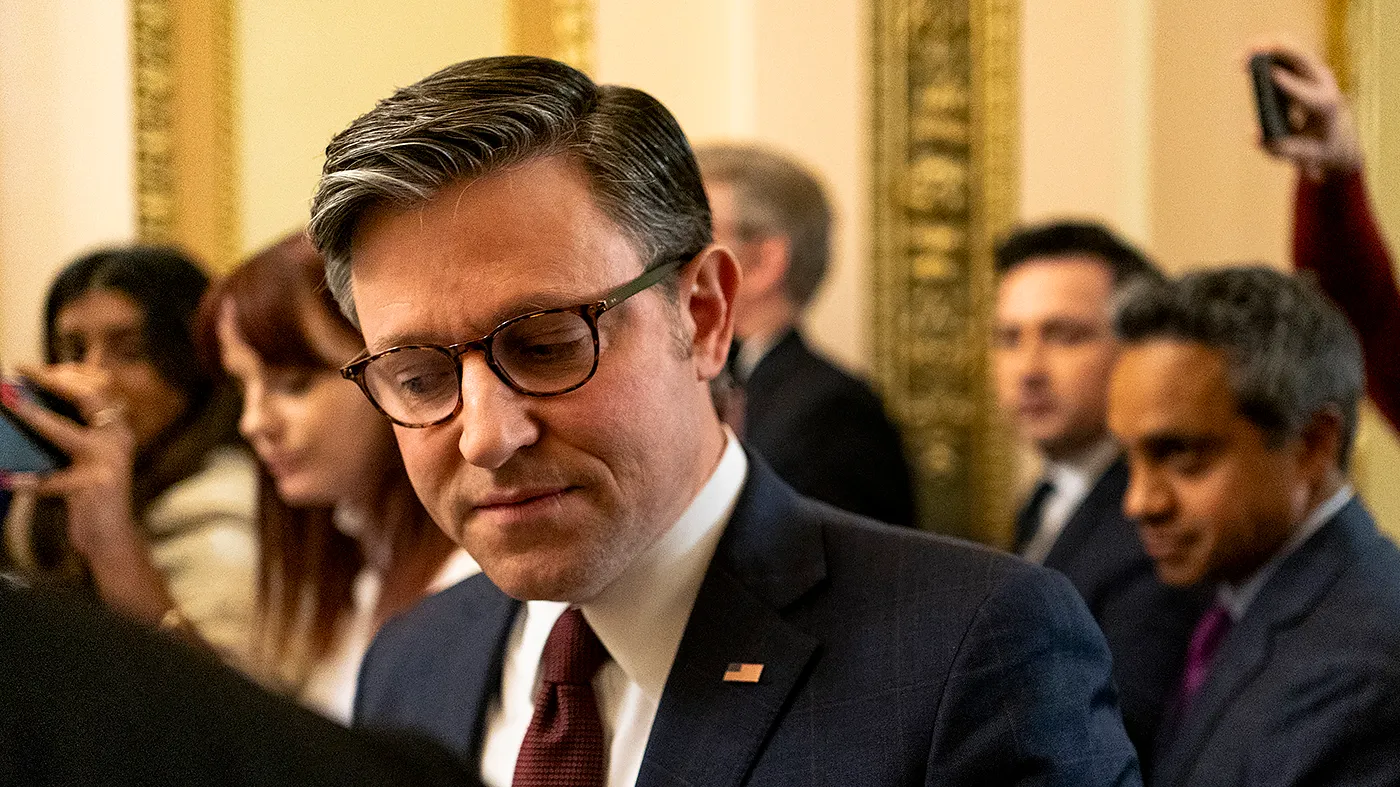
Speaker Mike Johnson’s (R-La.) job managing the House GOP’s paper-thin majority is getting only more difficult in the new year, with a culture of rebellion — and a perfect storm of external political factors — threatening to derail the party’s agenda just as Republicans are gearing up for a tough midterm cycle.
In the earliest days of the new session, Johnson and his leadership team have already had to swallow passage of ObamaCare subsidies — a vote forced by a handful of GOP mavericks — then watched in helpless frustration as some of those same centrist rebels blocked a series of Republican labor bills that were expected to pass easily and return some wind back in the party’s sails.
“It’s now become acceptable to use your leverage, because it’s a slim majority, to kind of just shift last-minute — shift the House, one way or another,” Rep. Mario Diaz-Balart (R-Fla.), a senior appropriator, said of the dynamic.
And the way to change that? “Increase the numbers,” Diaz-Balart said.
That won’t be easy. The struggle to pass even partisan messaging bills has not only highlighted the internal divisions within the restive Republican conference but also forecasts a stormy election year for GOP leaders, who are already fighting the headwinds of an unpopular president, a volatile economy and historic midterm trends, which predict losses for the party that controls the White House.
Last week, the Cook Political Report, an independent election forecaster, shifted its ratings of 18 seats — all of them in favor of Democrats.
Democrats have been only happy to underline the GOP’s troubles, saying Republicans have reached a level of dysfunction that makes them incapable of addressing the challenges facing working-class Americans who are struggling economically.
“This group of people, they don’t know how to organize a two-car funeral,” House Minority Leader Hakeem Jeffries (D-N.Y.) told reporters last week in the Capitol. “They’re losing votes week after week after week. The whole thing is falling apart.”
It’s not that there have been no victories. Johnson did succeed, with some assists from President Trump, in rallying the conference around key priorities last year despite grumbling from the various wings of the party. That list includes passage of the GOP’s One Big Beautiful Bill Act, which combined a host of Trump’s most prominent campaign promises — including sweeping tax cuts — into one massive package that became law on the Fourth of July.
Yet Republicans have had trouble selling that legislation to voters — one reason is that the tax cuts were largely an extension of existing law, meaning they were imperceptible to most people. While many Republicans are pushing for another party-line GOP spending bill this year, many of them doubt they can get the near-universal agreement they need to pass it.
Facing tough reelection contests, a large and growing number of vulnerable Republicans have shown an increasing willingness to go their own way for the sake of political preservation, even when it’s meant defying GOP leaders on major issues such as ObamaCare and the Jeffrey Epstein files.
The frequency of rebellion is amping up. Nearly every legislative week, GOP leaders have seen the House floor stalled or derailed as small groups of members flex their power.
Those detractors are often members of the right-wing House Freedom Caucus, which is known for such tactics. In recent weeks, those members have held up procedural votes as they demand amendment votes on funding bills, and in one instance got leaders to strip an earmark for a community organization in Rep. Ilhan Omar’s (D-Minn.) district.
But revolts against leadership are increasingly coming from the other side of the ideological spectrum, with moderate members in highly competitive districts joining with Democrats to force a vote on extending ObamaCare subsidies and to sink one GOP labor bill — prompting leaders to pull three more labor bills that were teed up for the week.
It’s a delicate balance for moderate swing-district members such as Rep. Rob Bresnahan (R-Pa.), a first-term lawmaker who signed the discharge petition to force a vote on the ObamaCare subsidies and also voted against the labor bill. Unlike Freedom Caucus members from deep-red districts, those moderates rely on national party structures to boost their reelection bids — but it can also help to look like they’re not in lockstep with Republican leaders.
Bresnahan said he’s had conversations with all the GOP leaders and understands their concerns, particularly about the discharge petition. But the choice, he said, was clear.
“I represent northeastern Pennsylvania and nobody else, so that’s where my loyalty lies,” Bresnahan said. “If it means deciding between, you know, party leadership or my district, it’s my district 100 percent of the time.”
The defections so far have been limited, in most cases, to handfuls of defiant Republicans. That’s largely because Trump, while unpopular nationally, still commands a firm grip on congressional Republicans, many of whom fear a primary challenge if they break with the president too frequently. But that might soon change, according to some Republicans, when the primary season ends.
“One of the reasons they’re attacking me, and putting so much money into my race, is to keep the others in line. And so far it’s working,” said Rep. Thomas Massie (R-Ky.), whose willingness to defy the president on major issues like Epstein have earned him a Trump-backed primary challenge. “But maybe once we get past May 19, and my colleagues get past their own primaries, they can start voting for their constituents and the Constitution.”
The early resignation of former Rep. Marjorie Taylor Greene (R-Ga.) on Jan. 5 and sudden death of Rep. Doug LaMalfa (R-Calif.) the following day put even more pressure on GOP leaders.
House Republicans can now afford only two defections and still win any party-line vote, assuming all members are present and voting. That margin will temporarily dip down to one once a Democrat is sworn in after a Texas special election at the end of the month.
Emphasis from leadership on attendance has resulted in ill and battered lawmakers making the trek to Washington when they otherwise wouldn’t have, since absences can make or break a vote.
Rep. Jim Baird (R-Ind.), who along with his wife was hospitalized after a car crash that his office said was a hit-and-run early this month, was present for votes this week— his neck in a brace, his face still black with bruises.
Democrats have had their own problems with absences, stemming from both health issues and races for different offices. It’s prompted concerns from Democratic leaders, who are urging members to get to the Capitol, especially for the big votes.
“When we have important votes that affect the American public, we expect members to be here,” Rep. Pete Aguilar (Calif.), head of the House Democratic Caucus, said earlier in the month. “We expect members to be here on time.”
Republican leaders have brushed off the losses on the House floor as just a reality of the slim House majority.
House Republican Conference Chair Lisa McClain (Mich.), the No. 4 Republican in charge of messaging for the House GOP, said she does not even view recent incidents as “rebellion.”
“I just see it as, that’s what happens when you have one-seat majority. Everything has to be amplified, right?” McClain said. “Everything that used to be kind of a given — I don’t want to say that, but the details — there’s just zero room for error. There’s just zero room for error.”
Even Johnson, while leaving the House floor after moderates tanked the labor bill, insisted: “We’re totally in control of the House.”
“This is life with a small margin. We’re not deterred in any way,” Johnson said.
Trump also has acknowledged the difficulties of a slim majority.
“A lot of times they’ll say, ‘I wish Mike were tougher.’ He’s tough,” Trump said in a speech to House Republicans earlier this month at the Kennedy Center. “But you can’t be tough when you have a majority of three — and now, sadly, a little bit less than that.”