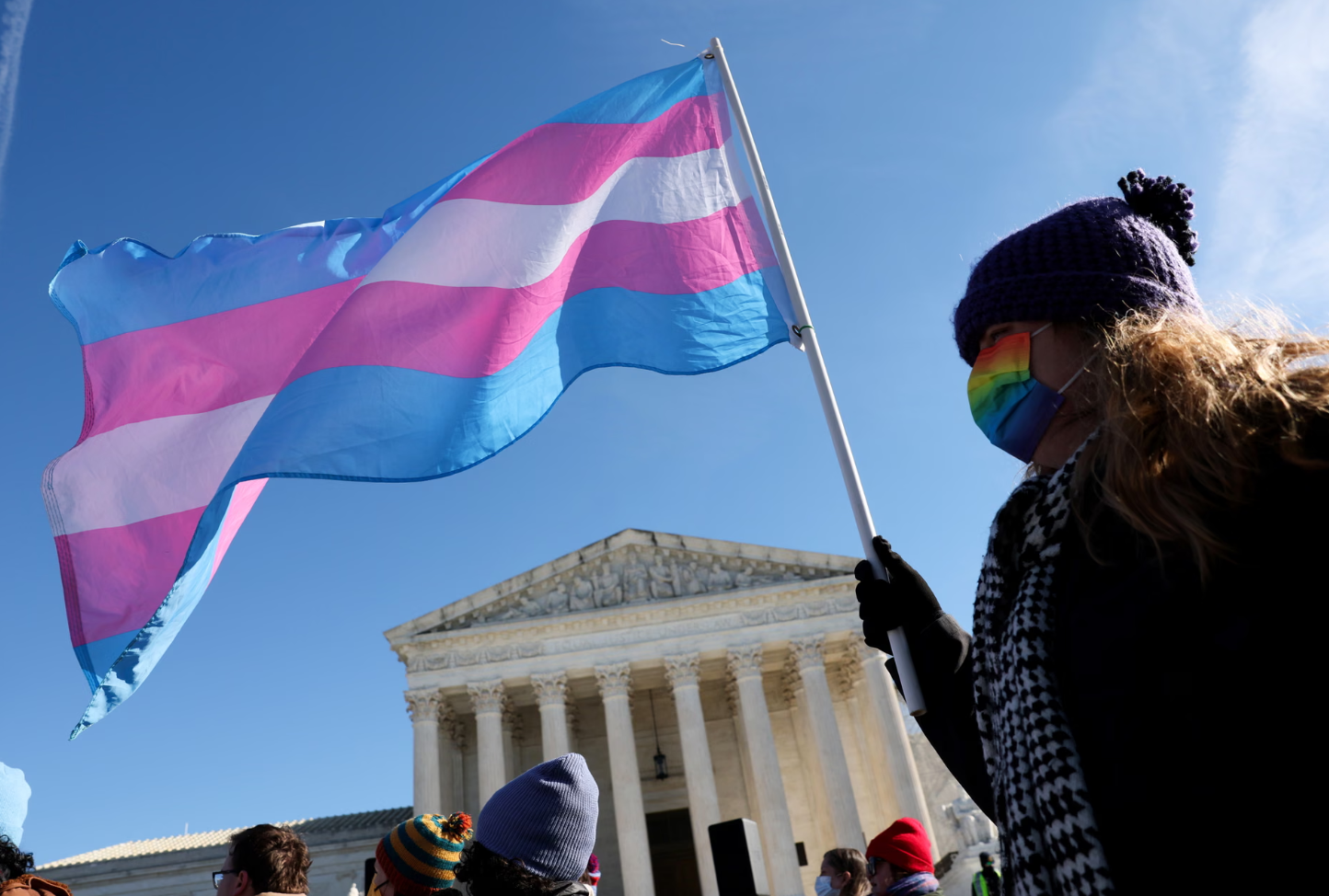
A ruling against two athletes in West Virginia and Idaho could have far-reaching implications for civil rights
The US supreme court on Tuesday appeared poised to uphold laws banning transgender girls and women from competing in female sports in two conservative states, in a landmark legal battle that could carry profound implications for trans rights across US society.
During oral arguments on two cases of trans students who sued over Republican-supported laws in West Virginia and Idaho that barred them from girls sports, one member of the court’s conservative majority after another voiced skepticism about the students’ cases.
The case had reached the court after West Virginia and Idaho appealed rulings by lower courts, which had ruled in the students’ favor.
Brett Kavanaugh, one of six conservative justices on the nine-member court, suggested the inclusion of trans girls potentially threatened the success of women’s sports in the US.
“One of the great successes in America over the last 50 years has been the growth of women and girls sports, and it’s inspiring,” he said.
He cited opinions from groups like the National Collegiate Athletic Association (NCAA) and the US Olympic committee suggesting that “allowing transgender women and girls to participate will undermine or reverse that amazing success and will create unfairness”.
The bans against transgender athletes are mirrored in 25 other states and are generally blanket prohibitions restricting trans youth of all ages from participating in all levels of athletics.
The laws are aimed at excluding a tiny fraction of the population, with GOP legislators at times unable to identify any trans girls playing sports in their states, and the NCAA president testifying he was aware of fewer than 10 trans college athletes.
Lawyers for the trans students, including the American Civil Liberties Union, argue the bans violate the equal protection clause of the constitution, excluding a small group of individuals from participating in the same activities as their peers. In the West Virginia case, attorneys argue the ban also violates Title IX, a federal law prohibiting sex discrimination in schools. The states are supported by the Alliance Defending Freedom, a Christian legal group behind major anti-LGBTQ+ cases and anti-abortion efforts.
The arguments centered around Lindsay Hecox, a college student in Idaho, and Becky Pepper-Jackson, a 15-year-old high school student from West Virginia.
Hecox had originally sued Idaho to overturn Idaho’s first-in-the-nation 2020 law categorically banning trans women and girls from women’s sports teams. She later pushed to have the case dismissed, saying she was no longer pursuing sports and feared harassment. But the supreme court still heard the case.
Her lawyer, Kathleen Hartnett, told the justices that when Hecox was playing sports, she was mitigating any competitive advantage she might have by taking testosterone suppressants and estrogen, countering Idaho’s justification of its ban.
In a separate hearing for the West Virginia case, the ACLU’s Joshua Block, representing Pepper-Jackson, explained that his client started gender-affirming treatment at a young age and did not go through male puberty, also eliminating any advantage.
“By virtue of her medical care, BPJ is … completely in the position that she would have been if her birth assigned sex had been female,” he said, referring to Pepper-Jackson by her initials.
“Virginia’s law treats BPJ differently from other girls on the basis of sex, and it treats her worse,” Block said. “BPJ signed up for school sports, because she was an 11-year-old girl starting a new middle school, who wanted to meet people, make new friends and be part of a team … If the evidence shows there are no relevant physiological differences between BPJ and other girls, then there is no basis to exclude her.”
Amy Coney Barrett, another conservative justice, asked if transgender girls with no competitive advantage can join girls’ sports, would boys be able to join a girls’ team if they had a similar skill level.
During argument on Idaho, the rightwing justice Clarence Thomas put the question more pungently, asking if there was any difference between what Hecox and Pepper-Jackson were seeking than a “lousy” tennis player who wants to join the women’s team, based on the argument that “there is no way I’m better than the women’s tennis players”.
Idaho’s solicitor general, Alan Hurst, agreed that it was not different.
Addressing Pepper-Jackson’s case, West Virginia’s solicitor general, Michael Williams, called it a “back door attack” on Title IX.
“West Virginia schools can no longer designate teams by looking to biological sex. Instead, schools must place students on sports teams based on their self-identified gender,” he said, arguing that this would deny cis girls opportunities.
His comments echoed the defenders of similar bans in other states, who argue they are promoting fairness and safety in women’s sports. Trans rights advocates counter the laws are cruel and discriminatory, and that there’s no credible evidence inclusive sports policies have endangered cis girls and women.
At one point, Ketanji Brown Jackson, a liberal justice, pressed Idaho’s solicitor general on whether the ban was discriminatory against trans people, asking: “It treats transgender women different than cis women, doesn’t it?” Hurst responded that it had a “disparate impact”, then claimed that “men who identify as transgender” had a “different reason for wanting to play women’s sports than biological females”.
The court, which has repeatedly ruled against trans rights, will consider whether the laws are discriminatory and merit “heightened scrutiny”, a rigorous review where the government has a higher burden to justify the bans. If the court’s conservative supermajority decides the bans don’t warrant heightened scrutiny, it could set a precedent that anti-trans laws are “presumptively constitutional”, the ACLU has warned.
If the court rules trans people are not covered by Title IX, it could boost policies meant to ban trans students’ bathroom access and ability to use chosen pronouns and names, and leave LGBTQ+ youth with fewer protections against harassment, bullying and discrimination.
Pepper-Jackson said in a statement last week that she plays sports to “make friends, have fun, and challenge myself through practice and teamwork”, adding: “All I’ve ever wanted was the same opportunities as my peers. But in 2021, politicians in my state passed a law banning me – the only transgender student athlete in the entire state – from playing as who I really am. This is unfair to me and every transgender kid who just wants the freedom to be themselves.”