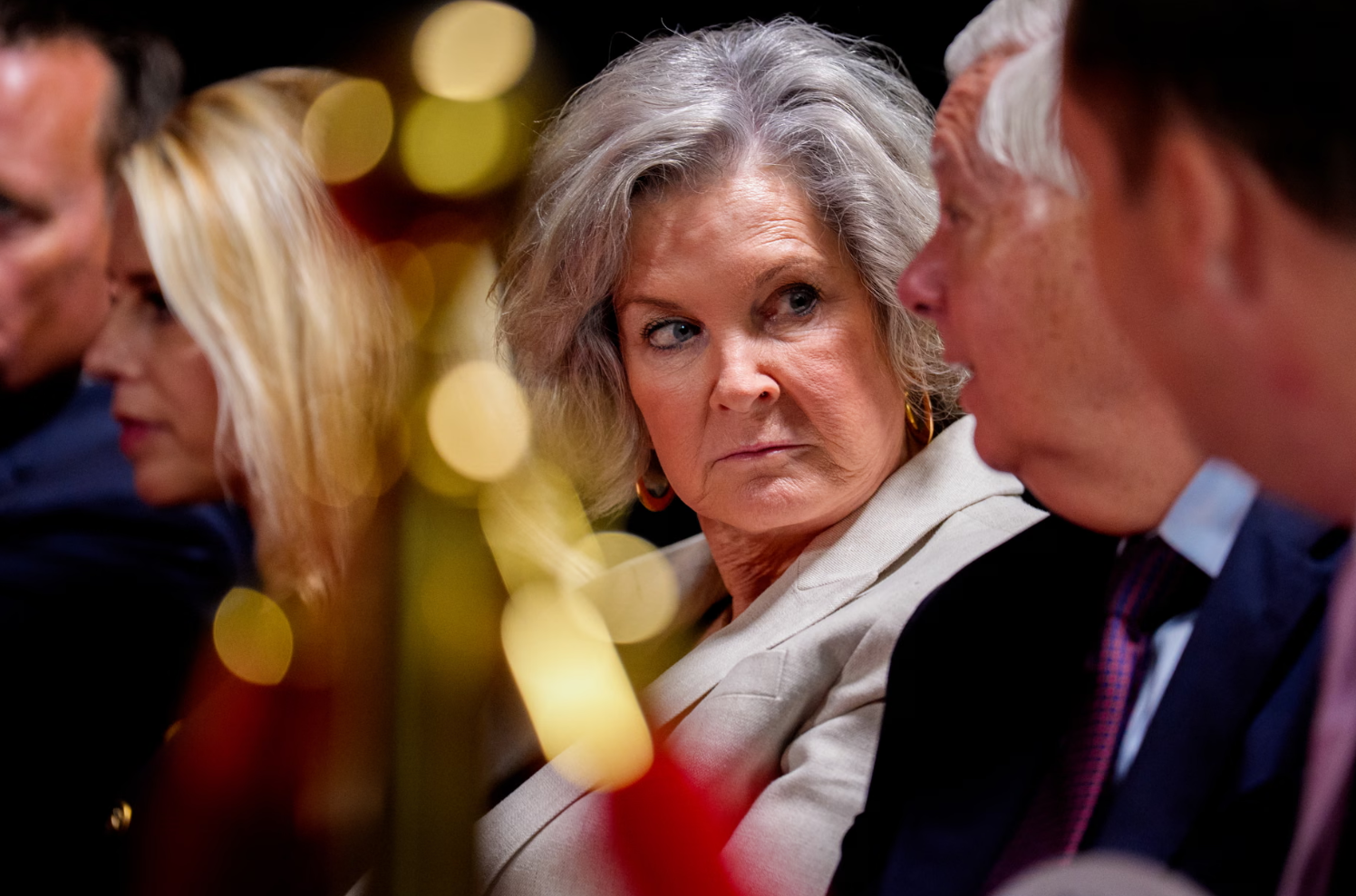
Are her recent candid remarks about Trump an attempt to distance herself from an increasingly unpopular president?
She was now one of the family. When Donald Trump addressed supporters in Mount Pocono, Pennsylvania, in early December, he asked: “Susie Trump – do you know Susie Trump? Sometimes referred to as Susie Wiles.”
The US president was referring to his chief of staff, who he said had persuaded him to return to the campaign trail ahead of the 2026 congressional midterm elections. But a week later, Wiles appeared at risk of becoming the family outcast.
In a 9,500-word Vanity Fair magazine profile based on 11 interviews conducted over Trump’s first year back in office, Wiles described the president as having “an alcoholic’s personality” and an eye for vengeance against perceived enemies.
The first woman to serve as White House chief of staff also called the vice-president, JD Vance, a “conspiracy theorist”, branded tech tycoon Elon Musk an “odd, odd duck” while criticising his dismantling of USAID, and gave juicy opinions on other Trump administration figures.
Wiles claimed that she had been selectively quoted for a “hit piece” while Trump, Vance and others rallied to her defence. But the bombshell article raised questions over Wiles’s motivations, her ideological alignment with Trump and her future as the linchpin of his administration.
Chris Whipple, who conducted the interviews, does not believe that they signalled Wiles’s intention to quit. He said: “I don’t think this was part of an exit strategy and I don’t think it was some sort of three- or four-dimensional chess.
“It was Susie Wiles saying out loud what she thinks and what she says in private to her colleagues. I don’t think she was taking a shot at JD Vance in order to elevate Marco Rubio or prepare the next step of her career. I just don’t think it’s that complicated.”
But some political commentators regard Wiles’s seemingly indiscreet remarks as the rumblings of a conscience and an attempt to rescue her legacy before a departure from the White House that may come to seem inevitable.
Rick Wilson, a political strategist and cofounder of the Lincoln Project, an anti-Trump group, said: “I’ve known Susie all my political life. There is 0.000 chance that this incredibly sophisticated and experienced political operative did 11 interviews on tape and did not know exactly what she was doing.
“It is beyond ludicrous to say, ‘Oh, well, she was tricked by a wily reporter.’ She’s done several thousand interviews, just like all the rest of us at this level, and she knows exactly what is going on. There’s a grey area here. She did this deliberately. Nobody wants to admit it, but she did it.”
Why? Wilson replied: “She is trying to have a plea bargain with history. She’s trying to start laying a predicate that says, ‘Well, I was there and I enabled it, but I got it. I got the joke. I knew what was happening and I’m not one of the bad ones.’ Her direct hits on all those people around Trump’s orbit did not go unnoticed by anybody. Everyone got the gag here. I don’t think she’s long for this White House.”
The Vanity Fair story was unusual because Wiles, 68, has been careful to cultivate a career as a supporting player away from the spotlight. The daughter of American football player and sportscaster Pat Summerall, she worked in the Washington office of New York congressman Jack Kemp in the 1970s then for Ronald Reagan’s campaign and in his White House as a scheduler.
She married Republican advance operative Lanny Wiles and relocated to Ponte Vedra, Florida, where they had two children (they divorced in 2017). After a few years away from politics, Wiles worked for Dan Quayle, the running mate of George HW Bush, and advised two Jacksonville mayors, John Delaney and John Peyton.
Peyton, now president of Gate Petroleum Company in Jacksonville, recalled: “She has a great sense of humour, extraordinarily witty, but is very private. She is never going to seek the limelight. She’s not going to want to be the speaker of the local rotary club. Does not want to be interviewed. She does her best work in small groups and she’s kind of shy, actually.”
Indeed, having co-chaired Trump’s successful 2024 election campaign with Chris LaCivita, Wiles refused to take the mic during his victory speech. Trump observed: “Susie likes to stay in the background … Look at this, she’s shy; I’ve never seen her be shy before. Susie!”
Peyton added: “She’s very effective behind the scenes. She’s been in politics a long time. She knows her job is to let her principal be the star of the show and she’s very disciplined about that.”
Wiles went on to work for Florida congresswoman Tillie Fowler. She then earned her spurs on statewide campaigns in rough-and-tumble Florida politics and was credited with helping businessman Rick Scott win the governor’s office.
After briefly managing Utah governor Jon Huntsman’s 2012 presidential campaign, she ran Trump’s 2016 effort in Florida, when his win in the state helped him clinch the White House. Two years later, at Trump’s urging, she helped get underdog Ron DeSantis elected as Florida’s governor.
But DeSantis soon turned on her, rebuking Wiles in public and traducing her in private; she told Vanity Fair she still does not know what caused the rift. Wiles went on to organise Florida for Trump’s 2020 re-election campaign.