A 1,000-strong “dark fleet” of rogue oil tankers skirting sanctions has emerged as a new target for the U.S. and Ukraine, a senior maritime intelligence analyst claims.
Michelle Wiese Bockmann warned the aging fleet poses geopolitical risks and threats of $1 billion oil spills, with the recent U.S. seizures in Venezuela and Ukrainian drone strikes in the Black Sea marking a turning point for both nations in their efforts.
“There are about 1,000 vessels worldwide that are trading sanctioned crude tankers containing sanctioned Iranian, Venezuelan and Russian oil,” Bockmann told Fox News Digital.
“These vessels are a lifeline for these regimes, because they’re used for shipping oil to fund the war in Ukraine, and also give money to the illicit Maduro regime,” she added.
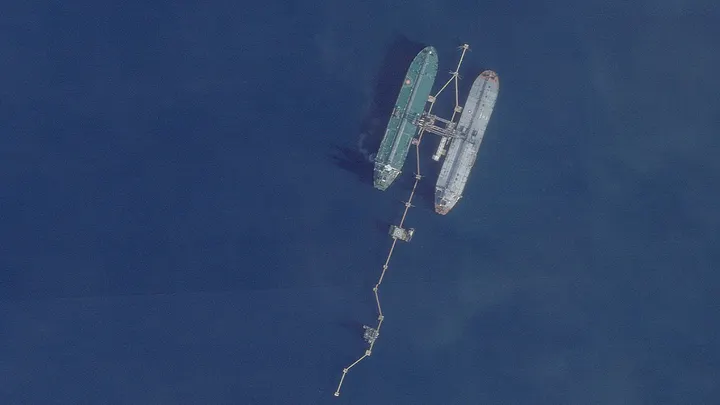
U.S. seized the Skipper, a Venezuelan oil tanker. ( Planet Labs PBC/Reuters)
“This is a brand-new problem for the U.S., and now Ukraine has signaled they are going to target these vessels the same way,” she said. “There is a new strategy to deal with this dark fleet, which is the lifeline of sanctioned oil revenues, and now under attack by the U.S. and Ukraine. The strategy is all to counter what we call gray-zone aggression.”
White House press secretary Karoline Leavitt was questioned about the U.S. seizing an oil tanker off the coast of Venezuela. (Planet Labs PBC/Handout via Reuters )
Recent Ukrainian naval drone strikes have disabled several tankers in the Black Sea, including the Dashan, part of Russia’s so-called shadow fleet that Ukraine says helps Moscow export oil in defiance of sanctions, according to Reuters.
“It is dangerous and could be interpreted as a form of gray-zone aggression in order to continue to keep oil revenue flowing,” Bockmann said.
“This is all a billion-dollar oil spill catastrophe waiting to happen,” she added, pointing to the environmental and navigational risks posed by poorly maintained, uninsured ships.
Footage of the Dashan tanker, purportedly part of the Russian shadow fleet hit by Ukraine. (Security Service Official/Handout via Reuters)
She said a subset of “about 350 to 400 vessels at any one time are not only sanctioned but falsely flying flags, which is dangerous,” because false registration leaves vessels stateless and uninsured, putting crews at risk.
“This is a huge issue for maritime safety, it’s a menace to the environment, and it entails crew welfare,” Bockmann said.
These vessels, she said, are typically “elderly” and used solely for sanctioned oil trades. Many also “manipulate AIS” to show they are in one place when they are actually elsewhere.
Dashan, a tanker from Russia’s shadow fleet, transits the Bosphorus en route to the Black Sea in Istanbul. (Yoruk Isik/Reuters)
“They use false flagging, but also spoofing and manipulating its AIS to show it’s in one place when it’s not. These vessels have also gone to fraudulent registries that don’t exist, which means they have no insurance,” she said. “Their certificates of seaworthiness are invalid, and they have relied on international maritime conventions to have what’s called the ‘right of innocent passage’ so they can’t get intercepted.”
Bockmann said U.S. forces have used legal tools including Article 110 of the United Nations Convention on the Law of the Sea, which allows boarding of stateless vessels, to stop these ships.
“It’s my belief that they used Article 110, and they got on board that vessel, and they were absolutely entitled to remove that vessel from global trade,” she said.
Attorney General Pam Bondi speaks during a roundtable meeting on Antifa with President Donald Trump in the State Dining Room at the White House, on Wednesday, Oct. 8, 2025, in Washington, D.C. (Evan Vucci/AP)
In the Caribbean, U.S. forces recently seized the tanker Skipper, sanctioned in 2022 and found to be masking its location, under a federal warrant as part of a broader campaign to disrupt illicit oil shipping.
“The recent Venezuelan tanker was carrying 1.8 million barrels of oil uninsured, so that’s a billion-dollar maritime disaster waiting to happen,” Bockmann said.
As reported by Fox News Digital, Dec. 12 saw Attorney General Pam Bondi frame the U.S. seizure of a Venezuelan crude tanker as a sanctions-enforcement action rooted in a federal court warrant.
Meanwhile, in the Black Sea, Ukraine targeted multiple alleged “shadow fleet” tankers with sea drones, according to Reuters.
“The three tankers that have been targeted by Ukraine are all in ballast, which means that they weren’t carrying oil,” Bockmann said.
“That was carefully chosen, and they were also falsely flagged, just like in the recent case of the three tankers attacked in Ukraine. That flag was Gambia. In the U.S. case of Skipper, the flag was Guyana,” Bockmann said.