Republicans are facing growing fissures on artificial intelligence (AI) standards as President Trump moves to impose a federal approach to regulating the growing industry.
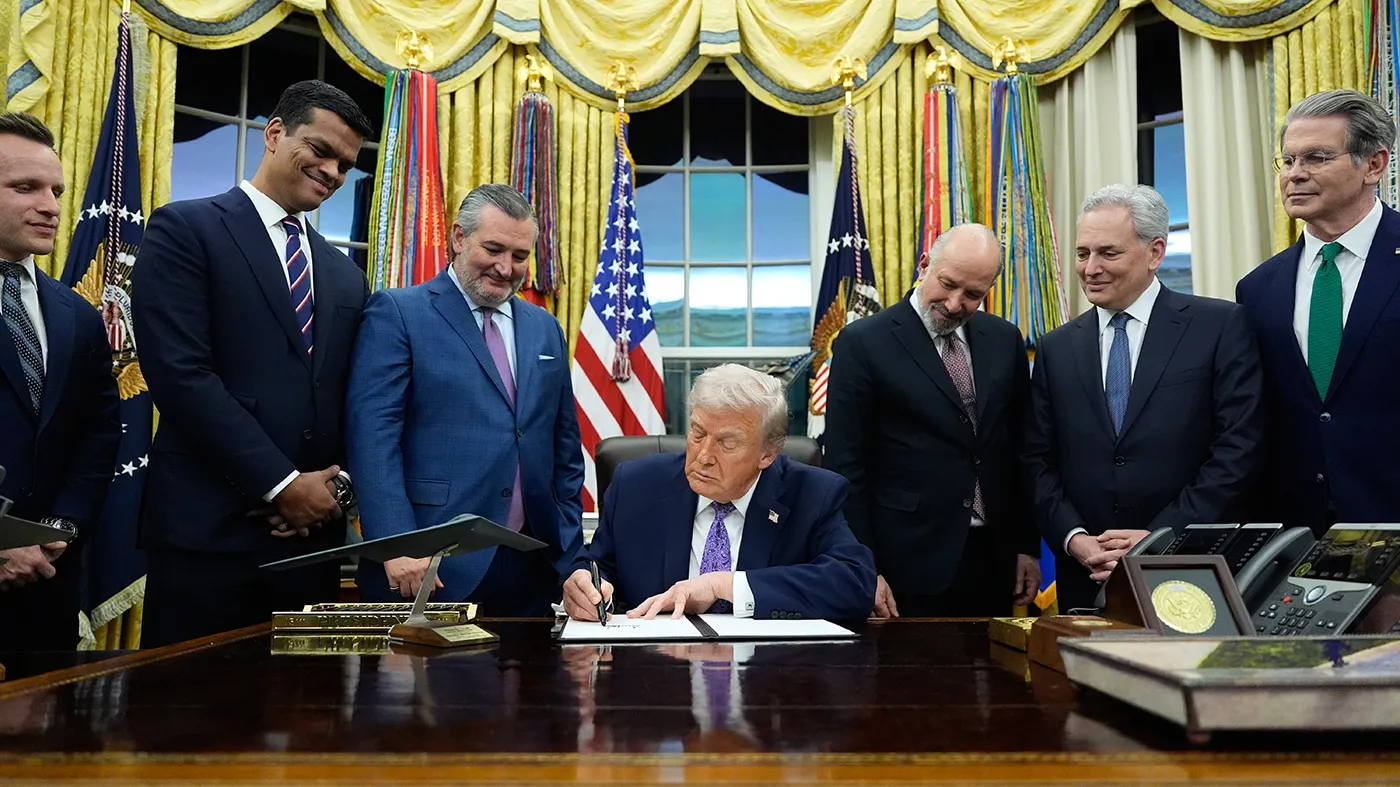
The president Thursday issued an executive order that seeks to institute a national AI standard by pushing back on state AI laws.
While the president has support from several prominent Republicans on the issue, others within the party have voiced their opposition to the push to limit states’ efforts to regulate AI, including Trump’s one-time rival Florida Gov. Ron DeSantis (R).
“You’ve got a whole cadre of senators and MAGA influencers that have staked out a position on AI that is not consistent with what the president signed yesterday,” said one Republican lobbyist.
Former Trump campaign adviser Steve Bannon, one of Trump’s staunchest allies, criticized the president’s move Thursday to hinder states from enacting their own AI regulations.
“After two humiliating face plants on must-past legislation now we attempt an entirely unenforceable EO — tech bros doing upmost to turn POTUS MAGA base away from him while they line their pockets,” Bannon said in a statement on the platform Gettr.
Major AI firms have argued that it would be exceedingly difficult to comply with a patchwork of state laws, especially for such a nascent industry. Numerous AI companies have pushed back on laws in California, as the Golden State has taken on an outsized role in advancing regulatory efforts.
Republican lawmakers have attempted to pass measures blocking state AI laws twice in the past six months — via Trump’s tax and spending bill this summer and via the National Defense Authorization Act (NDAA) late last month — but both efforts ultimately fell short because of GOP infighting.
The Republican fight over AI is reflective of the intraparty divide on other issues that pit Trump’s working-class base against the business wing of the GOP.
“For people like Bannon and others, it’s about the displacement of the working class,” the Republican lobbyist said.
One GOP strategist characterized the divide among Republicans on AI as “a combo of federalism coupled with very deep, embedded concerns by a lot of our base and activists against Big Tech.”
“Politicians are really engaged in the federalism fight,” the strategist noted. “I think a lot of activists are more concerned about the Big Tech pushing for it.”
“Jobs are at stake, privacy is at stake, our battle against China is at stake,” the strategist said. “It’s fascinating to see the politics influencing how we figure that all out.”
DeSantis has also emerged as a particularly vocal critic of the preemption push. As lawmakers contemplated adding a provision to the NDAA late last month, he suggested it was “a subsidy to Big Tech.”
“The rise of AI is the most significant economic and cultural shift occurring at the moment; denying the people the ability to channel these technologies in a productive way via self-government constitutes federal government overreach and lets technology companies run wild,” DeSantis wrote in a post on the social platform X.
He remained defiant in the face of a potential executive order, arguing Monday that such an order could not limit states’ powers under the 10th Amendment.
“Overall, Republicans have been fairly deferential to President Trump,” noted Andrew Lokay, a senior research analyst at Beacon Policy Advisors.
“But I think for Republicans, particularly at the state level, who have the most to lose from federal preemption and have a little bit more distance from Washington, D.C., they may be more willing to speak out,” he added.
Last week, DeSantis rolled out what he dubbed a proposal for a “Citizen Bill of Rights for Artificial Intelligence” aimed at protecting consumers from the potential risks and harms that come with AI.
One source familiar with the governor’s thinking noted the governor’s AI proposal is not in conflict with the president, arguing that DeSantis’s proposal does not hinder the ability to innovate AI.
“What the governor is proposing is consumer protections for people and children around AI use. Think deepfakes. So it’s not really stifling AI in the state, just protecting it from being misused to hurt people,” the source said. “I don’t think the president‘s executive order is in conflict with that.”
Trump’s executive order seeks to push back on “onerous” state AI laws, which the administration has argued could stifle innovation as the U.S. competes with China to dominate the technology.
“You have to have a central source of approval,” Trump said from the Oval Office on Thursday. “When [companies] need approvals of things, they have to come to one source. They can’t go to California, New York and various other places, like Illinois.”
“There’s only going to be one winner here, and that’s probably going to be the U.S. or China,” he added.
Thursday’s order largely resembles a draft seen by The Hill last month, directing administration officials to create a task force to challenge state AI laws and establish a policy to block broadband funding to states with laws deemed overly burdensome.
However, it notably included a new section clarifying that recommendations for a federal AI framework “shall not propose preempting otherwise lawful” state measures on kids’ safety, AI infrastructure and state procurement and use of AI.
This appears aimed at addressing at least some of the concerns that have split Republicans in recent months.
Sen. Ted Cruz (R-Texas) has positioned himself as a key ally of Trump on the issue, notably standing beside him in the Oval Office on Thursday as he signed the executive order.
“He went full tech bro,” the Republican lobbyist said, referring to Cruz.
The positioning of prominent Republicans, like Cruz and DeSantis, could show splinters of where the GOP could be heading after Trump.
“To see the likes of Cruz on the one hand and DeSantis on the other paints an interesting picture as to two potential guys who could be vying for the party’s nomination in a few years,” the GOP strategist said.