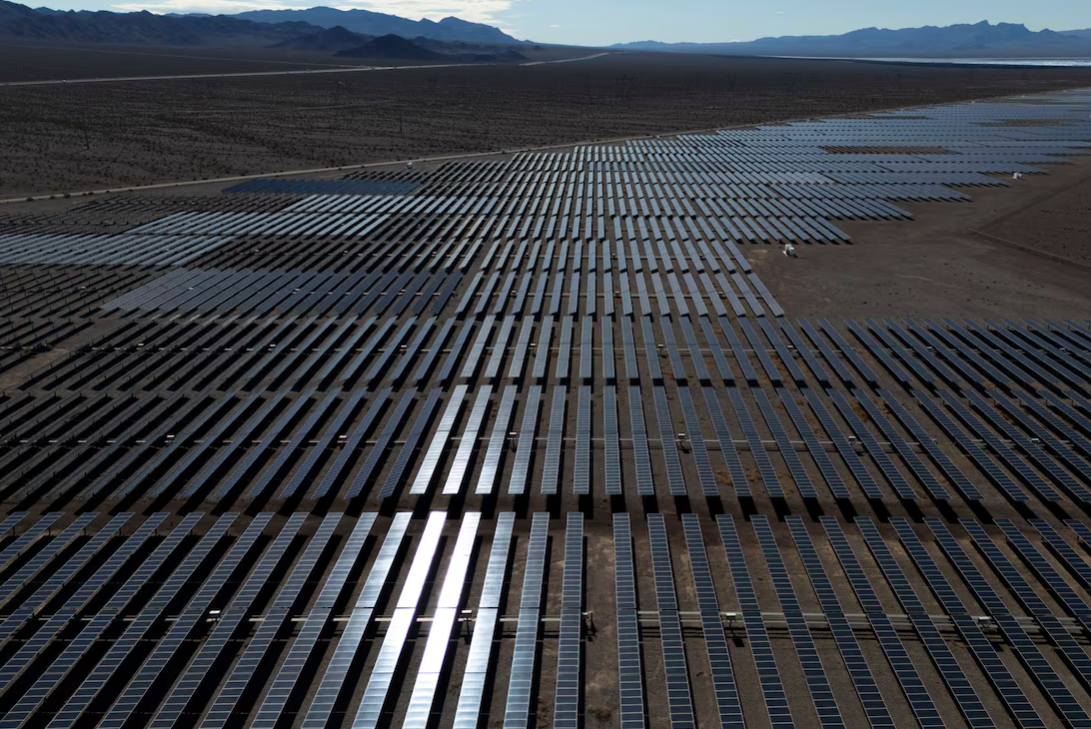
Dec 10 (Reuters) – U.S. President Donald Trump’s freeze on approvals for major onshore wind and solar projects is leaving thousands of megawatts of clean power capacity in limbo at a time of soaring demand for electricity, a Reuters review of permitting data and interviews with industry officials shows.
Just one solar project has been approved on federal lands since Trump took office in January, and none have been permitted since July when Interior Secretary Doug Burgum ordered that all new decisions related to renewable energy projects require his personal sign-off.
That compares to 13 solar and two wind projects approved on public lands under former President Joe Biden.
Trump, who has called climate change a hoax, has promised to fast-track energy infrastructure to meet rising electricity demand from artificial intelligence and data centers, declaring an “energy emergency” to keep the United States competitive. But that policy excludes wind and solar projects.
The bottleneck extends to renewable projects proposed on private and state lands too, because they often require federal permits for wildlife or water impacts or access roads, according to developers and government officials.
Reuters examined permitting databases maintained by the U.S. Department of the Interior and spoke with 10 industry representatives for this story.
Energy research firm Wood Mackenzie said it has identified 18 gigawatts of solar projects on federal lands that were canceled or are inactive due to limited development progress since the start of the year.
“It’s extremely detrimental to our industry because it just upsets the ability to deliver projects,” said Abigail Ross Hopper, president of the Solar Energy Industries Association, which estimates that more than 500 solar and storage projects are threatened by the freeze.
Last week, more than 100 solar companies penned a letter to Congressional leaders urging them to revoke the Interior Department policy, which they said amounted to a near moratorium on new permits.
“It is difficult to understand how these actions align with the President’s stated goals of unleashing American energy and ensuring energy affordability,” three Democratic senators, Michael Bennet, John Hickenlooper and Ben Ray Lujan, said in a letter to Burgum last month.
U.S. electricity demand is expected to increase 32% by 2030, with data centers accounting for more than half that growth, according to an analysis by power sector consulting firm Grid Strategies.
An Interior Department spokesperson defended its approach, without confirming the details of the Reuters reporting. “The Department continues its heightened oversight of wind and solar projects on public lands and waters to protect America’s national security and critical infrastructure,” the agency said in a statement.
The freeze of onshore projects has been happening quietly in the background of the administration’s very public assault on offshore wind, a nascent industry in the U.S. that has been hit with stop-work orders, funding cancellations and revoked approvals for fully-permitted facilities. A federal court ruled on Monday that the administration’s suspension of leases and permits for new wind projects was illegal.
Trump has repeatedly argued renewable energy sources like solar and wind are too expensive, receive unfair subsidies, and are less reliable than fossil fuels because they depend on the wind blowing or the sun shining.
Instead, the administration has moved aggressively to expand fossil fuel production, accelerating leasing for oil, gas and coal projects, and ordering a cut in permitting timelines for fossil energy projects and mines to no more than 28 days.
“President Trump’s energy dominance agenda unleashes our abundant resources like oil and gas, positioning the United States to win the AI race while simultaneously lowering energy prices and increasing grid efficiency,” Taylor Rogers, a White House spokeswoman, said in an email.