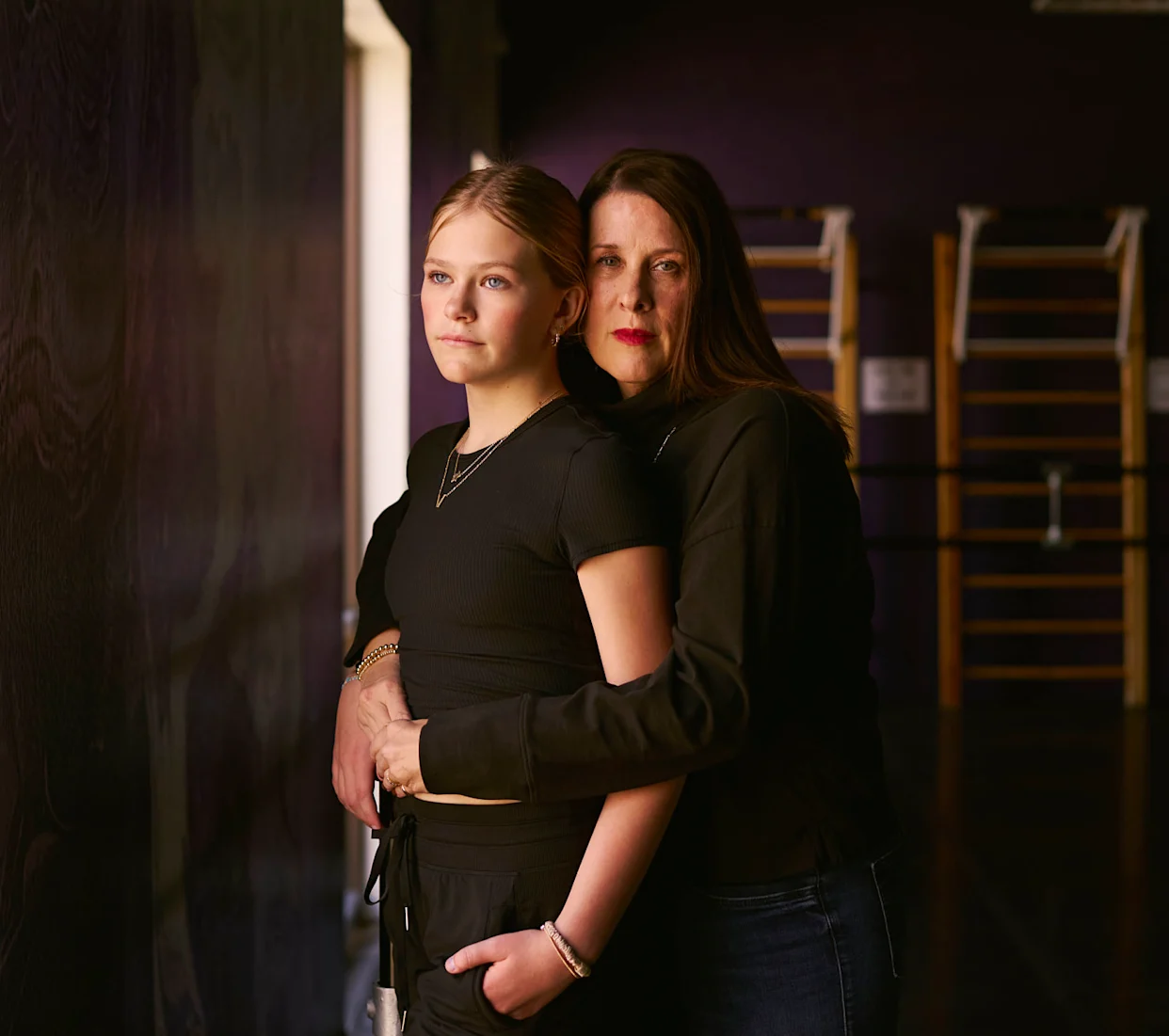
Anne Marie Hukriede has three times appealed her insurance company’s decision not to cover her daughter’s scoliosis surgery.
The answer each time was the same: Aetna considers the procedure that doctors recommend for her 12-year-old daughter, Vivian, to be experimental, citing a lack of evidence about long-term safety and efficacy.
When the company’s third denial came on Nov. 11, Vivian’s surgery was just days away. Given that the procedure can cost up to $100,000 out of pocket, the family postponed it.
Hukriede, who lives in Centennial, Colorado, exhausted her final chance for appeal last month. Now, the ideal window for Vivian to access the treatment is closing, since the surgery must be done while a child still has a sufficient amount of growing to do. (Peak growth spurts for girls typically occur between ages 10 and 14.)
“It’s disheartening, frustrating,” Hukriede said. “You get angry. We pay a lot of money in insurance premiums to have things covered.”
Scoliosis involves an abnormal curving of the spine that’s most often detected in adolescents. Around 3 million cases are diagnosed each year. While most are mild and don’t cause symptoms, moderate or severe cases can lead to back pain, breathing problems and reduced mobility. For Vivian, whose spinal curve resembles a question mark, the condition makes it painful to sit in school or attend dance competitions — her favorite activity.
“There’s a lot of things I can’t do easily because of my back,” Vivian said. “I really want to keep dancing, and I think the surgery will make dancing a lot easier.”
With Vivian’s dance competition season set to start in January, the Hukriedes sued Aetna on Monday, asking a Colorado district court to compel the company to overturn its denial.
In a statement, Aetna said it is “committed to supporting physicians in making care decisions for their patients based upon the best available medical evidence, including peer-reviewed studies and regularly updated clinical guidance.”
The company did not respond to NBC News’ inquiry about the lawsuit.
The surgery Vivian’s doctor recommended, called vertebral body tethering (VBT), involves attaching a flexible cord known as a “tether” — made by the medical device company Highridge — to vertebrae along the curved section of the spine. As the child grows, the tether straightens the curve by slowing growth on one side of the spine and promoting growth on the other.
The Food and Drug Administration approved the tether in 2019 for children with worsening scoliosis, determining that “the probable benefits outweigh the probable risks.” Many doctors recommend it for adolescents whose spines are still growing, meaning there’s still time to correct the curve. The Scoliosis Research Society and the Pediatric Orthopedic Society of North America jointly recommend that insurance companies cover the surgery. But, like Aetna, many other insurance companies still consider it too experimental.
In Vivian’s case, Aetna said that a team of clinical experts “concluded that VBT is outside the standard of care for a 12 year-old child presenting with scoliosis.” The company added that “data show that VBT procedures have higher complication rates with inferior outcomes compared to standard posterior spinal fusion for scoliosis.”
The standard fusion surgery the company referenced uses rods and screws to stiffen the spine. But rods can limit people’s motion and injure healthy discs, potentially leading to back pain or a need for additional surgeries later. With the tether, surgeons say, patients can keep their range of motion without the risk of disc degeneration. Either option requires a hospital stay of around two to three days, and the recovery afterward can be shorter for tethering.
The main risk of the tether is that because it’s flexible, it will break eventually. Around 20% of patients will need a spinal fusion or follow-up surgery to replace it, surgeons estimate.
Four surgeons who are not involved in Vivian’s case but also perform vertebral body tethering pushed back on Aetna’s characterization of the surgery’s risks and outcomes, saying that the benefits have become clearer over time as surgeons learn which patients are a good fit.
“That’s a sad day for me when I see somebody who truly is an indicated, ideal candidate for the procedure and I cannot provide that,” said Dr. Daniel Hoernschemeyer, a pediatric orthopedic specialist at the University of Missouri Health Care, who is a paid speaker for Highridge and sits on its medical education team.
Several surgeons said denials like the one from Aetna are an example of a pattern in which insurance companies are slow to change their coverage policies to include the latest medical innovations. A few reported spending hours each week arguing with insurance companies over denials for tethering surgeries.
These debates between doctors and insurers have played out amid a national conversation about the cost of health insurance in the United States. Disagreement in Congress over extending subsidies to make Affordable Care Act premiums more affordable gave rise to the record-breaking 43-day government shutdown that began in October. Around 42% of U.S. adults say it’s difficult to afford health care costs even with insurance, according to a May survey from KFF, a nonprofit health think tank.
For vertebral body tethering surgeries in particular, all of the surgeons interviewed said they think insurance companies should cover the surgery more often.
“We’ve had over 100 or so articles published on patients and outcomes. So in my world, when I offer this to patients, I no longer consider it an experimental surgery,” said Dr. Mohammed Alshareef, a pediatric neurosurgeon at Children’s Hospital Colorado.
“In general, insurance companies are wary about new devices that come into the health care and medical field, and so they would like long-term data,” he added.
Dr. Amer Samdani, a pediatric neurosurgeon at Shriners Children’s Philadelphia, said the tether works best for patients with curves in their lower spine and athletes who don’t want to give up their range of motion. But many hospitals still don’t offer the surgery, he said, in part because it requires additional training and comes with insurance hassles.
“The biggest barrier is insurance,” said Samdani, whose research was pivotal to the FDA approving the tether. Because of his role in the invention, he receives royalties and consulting fees.
“Even at our hospital, the initial response [from insurance] is a ‘no,’ probably 90, 95% of the time,” he added.
Aetna recently approved a tethering surgery for a 14-year-old girl in California after an independent review of the case determined it was medically necessary, NBC News found. The patient got the operation about three months ago.
The FDA approved the tether based on a study of 57 patients who received the device. After two years, 43 saw sufficient improvement in the curvature of their spines. A follow-up study, which Samdani co-authored, found no major complications post-surgery. However, one patient went on to receive a spinal fusion and seven patients required a second tether, in most cases because the first surgery overcorrected their curve.
A separate, smaller study last year followed 29 patients for an average of more than five years after vertebral body tethering and found that the surgery had a 64% success rate — lower than the average success rate of a spinal fusion. However, the patients were some of the earliest to receive the surgery, so doctors say success rates could be higher now that they’re better at identifying ideal candidates.
“The worst case scenario is it doesn’t work and a patient gets a spinal fusion,” Samdani said. “Whereas, if it works, you’re able to save motion, and hopefully that child can have less pain and less issues as they age.”