House Republicans have an exodus problem.
More than two dozen GOP lawmakers have already announced their decision to leave their seats at the end of the term, and the number is expected to grow in the coming weeks as lawmakers visit their families for the holidays, complicating Republican efforts to fend off a blue wave and keep their slim majority.
The reasons are numerous, and the trend is hardly new: Retirements have historically spiked for the party of the president in the midterm cycle. But the numbers are on track to reach 2018 levels — when Republicans got clobbered — and the dynamic is creating huge headaches for GOP leaders scrambling to protect President Trump from a Democratic House in his final years in office.
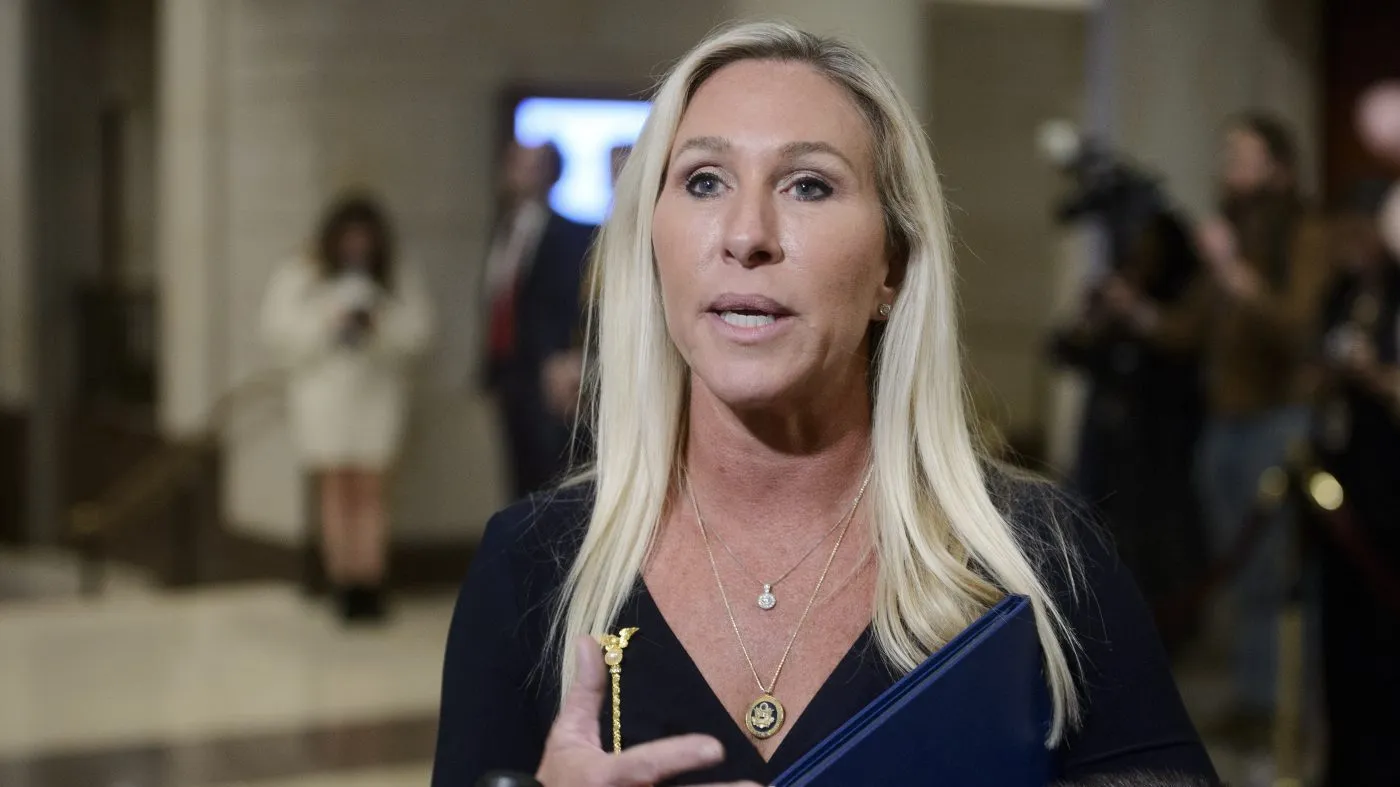
Rep. Marjorie Taylor Greene (R-Ga.) sent shock waves throughout Capitol Hill when she announced she would resign as of Jan. 5, fed up with her party’s handling of health care, foreign policy and other issues. Her departure echoes a broader trend: 23 House Republicans so far are retiring or seeking another office, while four Republicans have chosen to resign. In comparison, 17 Democrats are retiring or seeking another office.
The roster spans the GOP spectrum — from high-profile conservatives such as Texas Reps. Chip Roy, Jodey Arrington, and Michael McCaul, to battle-tested moderates such as Rep. Don Bacon (Neb.), who has repeatedly run for reelection and won in a competitive district.
By this point in the 2018 midterm cycle during Trump’s first term, 20 House Republicans had announced they wouldn’t seek reelection, according to data from Ballotpedia. Six House Republicans had left office early or announced resignations. Those figures are close to the current numbers.
Overall, 34 House Republicans chose not to seek reelection and 14 had resigned during their term in the 2018 cycle. Democrats ended up winning control of the House that year.
“Ultimately, the number of Republican retirements that we see compared to 2018 — I would imagine it would be close to the same number when all is said and done,” said Erin Covey, House editor at the nonpartisan Cook Political Report.
A number of House Republicans said they weren’t surprised by the turnover.
“I’ve been here five terms now, and every, you know, basically midterm cycle, you continue to see that play out where, you know, there’s people that step aside. Some just — they’ve been here long enough, and they’ve decided they had enough,” Rep. Brian Mast (R-Fla.) said.
“Some are tired of having to fight the swing districts that they’ve had. There’s a myriad of reasons. And some are just trying to move on to, you know, something that they might consider more fulfilling,” he added.
Bacon told The Hill last month that “if you’re not fired up about winning, that’s time to move on. And that’s how I felt.”
Frustrations with leadership and congressional inaction have also dominated the lower chamber in recent months, driving some lawmakers to leave their posts.
Greene echoed those sentiments in her resignation statement, arguing nothing gets better for the American people “no matter which way the political pendulum swings.”
Rep. Thomas Massie (R-Ky.) told The Hill that “everybody in the Republican Party, with the exception of just a few, are consigned to be automatons.”
“They just have to do whatever Trump wants them to do. What fun is that, if you’re an adult? Most of my colleagues are successful people who worked really hard to get here, and then they find out you’re just a rubber stamp for the Speaker who’s a rubber stamp for the president. I don’t blame them for running for another office or going back home,” he said.
Massie has frequently sparred with Trump, most recently outmaneuvering him on legislation requiring the Justice Department to release files related to convicted sex offender Jeffrey Epstein.
Rep. Kevin Kiley (R-Calif.) said that there’s been a “lot of dysfunction” in Congress, including a government shutdown that lasted 43 days and the “silliness of censure resolutions going back and forth.”
“Even the fact that the House has been, you know, divesting itself of some of its own powers when it comes to things like, you know, its authority on tariffs and that sort of thing. Of course, the redistricting war that’s bad for people on both sides, and that House leadership has refused to do anything about. So, yeah, I think those are all sources of frustration,” he said.
“I do think that there’s maybe some people who say, like, you know, at some point … if they feel like they can’t accomplish the things that they came here to do, then maybe that weighs into their decision. And I think the fact that you have the House of Representative gone for two months, for example, yeah, that makes it harder for people to do the things that they came here to do,” he added.
Republicans acknowledge the job can often feel isolating. Rep. Ronny Jackson (R-Texas) noted many of his fellow colleagues he knows are stepping away to spend more time with their families.
But whether the turnover will tip the scales of the 2026 midterm election remains to be seen.
Most House Republicans who are leaving represent districts that are red. But Bacon’s seat is rated as leaning Democrat, while Rep. David Schweikert’s (R-Ariz.) seat is listed as a Republican toss-up, according to Cook Political Report.
Rep. John James’s (R-Mich.) district is leaning Republican, while Rep. Ashley Hinson’s (R-Iowa) seat is likely Republican.
And then there’s the redistricting war going on as a backdrop, with both sides pressing to save seats.
Rep. Randy Fine (R-Fla.) suggested the turnover could be beneficial by opening the door for new voices and enthusiastic people to enter Congress.
“Fresh blood is good. … I don’t think people serving for 50 years is a great thing, so I think turnover is a good thing,” Fine said.