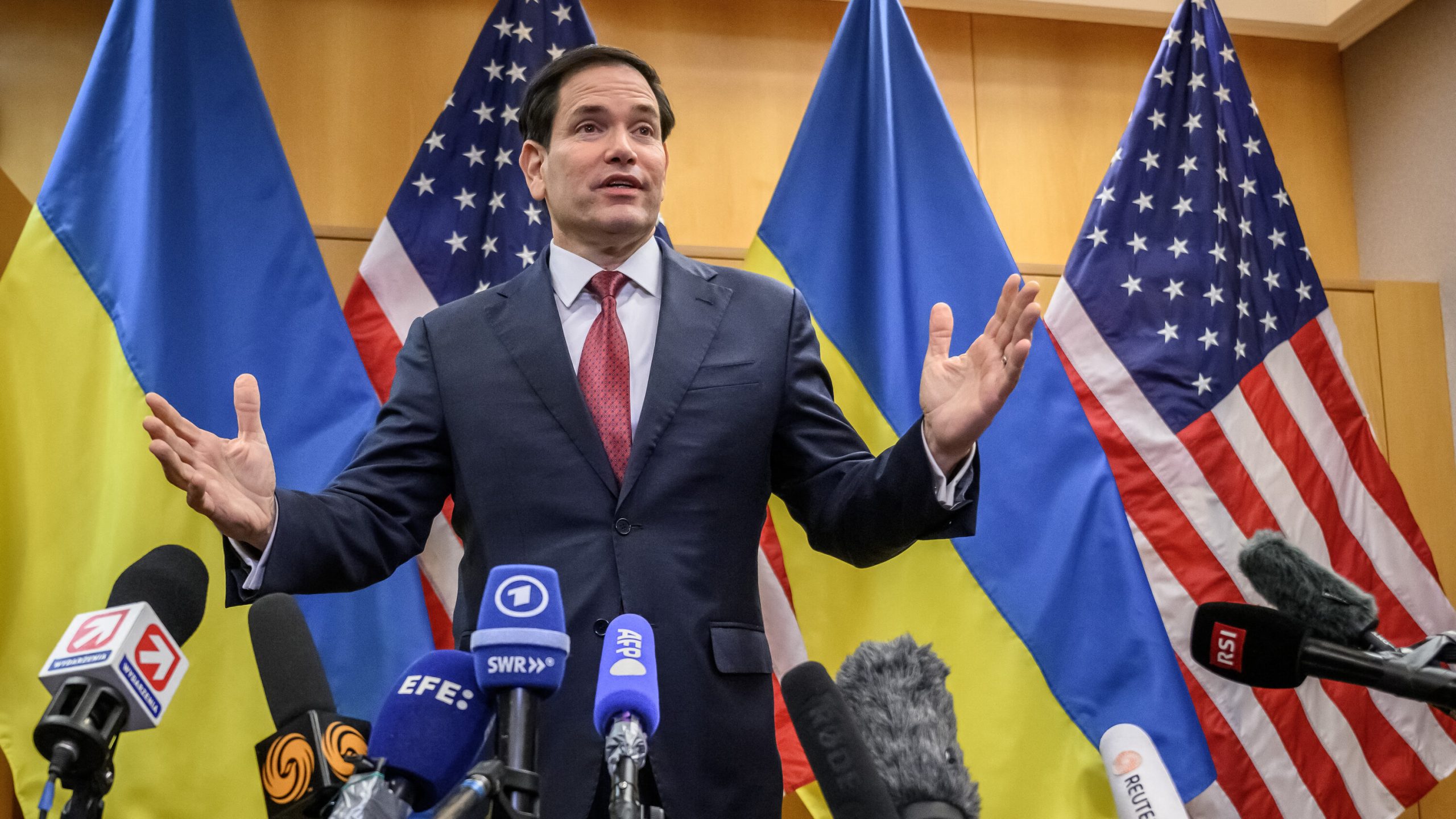
LONDON — U.S. Secretary of State Marco Rubio said Sunday that peace talks with U.S., Ukrainian and European officials gathered in Geneva, Switzerland, were “probably the most productive and meaningful meeting we’ve had so far in this entire process since we became involved.”
Officials met in Geneva at the U.S. Mission to discuss the contentious American peace plan proposal put to Kyiv this week, with terms critics say would constitute a Ukrainian capitulation.
In a brief gaggle with press at the U.S. Mission, Rubio noted that the presidents of both countries would have to approve any framework, but said he was “comfortable” they would.
“We’re making some changes and adjustments in hopes of further narrowing the differences and getting closer to an outcome that both Ukraine and the United States can be comfortable with,” Rubio said.
The U.S. delegation included Rubio, Army Secretary Daniel P. Driscoll and U.S. envoy Steve Witkoff, as well as U.S. Ambassador to Ukraine Julie Davis, Jared Kushner, State Department Counselor Michael Needham, Deputy National Security Adviser Andy Baker, and EUCOM and NATO Supreme Allied Commander Gen. Alexus Grynkewich, according to U.S. officials.
Rubio later Sunday said that all parties had made “great strides” on a potential peace settlement with Russia. He also said that the deadline for the parties to reach an agreement is “as soon as possible” and that a deal could slide past a Thanksgiving deadline imposed by President Trump.
“The deadline is we want to get this done as soon as possible. Whether it’s Thursday, Friday, Wednesday, Monday the following week … our goal is to get this done as soon as possible,” Rubio said, adding that the plan could also change as negotiations proceed.
“It evolved. This is a work – this is a living, breathing document every day with input, it changes,” he said.
A U.S. official told ABC News that Driscoll held “good meetings” with the Ukrainian delegation on Saturday night, which the official described as “positive and constructive.”
U.S. President Donald Trump, meanwhile, suggested on Saturday that there is room for further negotiation. Asked by reporters whether this was his last offer, Trump replied, “No.”
“We’d like to get to peace,” Trump said. “One way or another we’ll get it ended.”
But on Sunday, the president criticized Ukraine and its European backers, saying Ukrainian “‘leadership’ has expressed zero gratitude for our efforts” and noting that “Europe continues to buy oil from Russia.”
Asked later Sunday whether the president still considered the Ukrainians “ungrateful,” Rubio said he believed Trump was now “quite pleased” with progress at the negotiating table. He repeatedly called it the “most productive” day of talks with the Ukrainians since the administration took office.
Andriy Yermak, the head of Ukrainian President Volodymyr Zelenskyy’s office and the leader of Kyiv’s delegation in Geneva, said in a post to social media that the Ukrainian group was “in a very constructive mood” as it began meetings with European officials.
Additionally, Rustem Umerov, head of Ukraine’s National Security and Defense Council, said in a social media post Sunday that the proposals “while still not finalized include many Ukrainian priorities.”
“We appreciate our American partners working closely with us to understand our concerns to reach this critical point and we expect to make more progress today,” the post added.
Ukrainian President Zelenskyy posted Sunday, following a call with French president Emmanuel Macron, that “our teams in Geneva are working with partners, and it is very important that there is a practical result and that it brings Ukraine and all of Europe closer to reliable peace and security.”
In what appeared to be a nod to President Trump’s social media posts, Zelenskyy also addressed the U.S. and Trump, saying in part “we count on our partners to hear our arguments. The leadership of the United States is important, we are grateful for everything that America and President Trump are doing for security, and we keep working as constructively as possible.”
Zelenskyy also wrote in part that “the crux of the entire diplomatic situation is that it was Russia, and only Russia, that started this war, and it is Russia, and only Russia, that has been refusing to end it throughout the full-scale invasion,” elaborating on continuing Russian assaults in Ukraine.
A U.S. official told ABC News that there are plans for the U.S. delegation to hold a separate meeting with a Russian delegation. No details were provided about the location of the planned meeting with the Russians. Rubio, however, said it was “possible” that Trump and Zelenskyy could speak on the phone Sunday.
The U.S. has threatened Ukraine with a complete halt to all assistance if Kyiv does not agree to the proposed deal, a high-ranking Ukrainian official close to the matter told ABC News on Sunday.
This halt would include the supply of air defense missiles, as well as intelligence sharing and all other commitments related to weapons deliveries and support from the U.S., the official said.
Zelenskyy on Sunday confirmed that meetings were underway in Switzerland. “It is good that diplomacy has been reinvigorated and that the conversation can be constructive,” he wrote on Telegram.
“The Ukrainian and American teams, as well as the teams of our European partners, are in close contact, and I do hope that there will be a result,” he said. “The bloodshed must be stopped, and we must ensure that the war is never reignited.”
Later, the president said in another post that he had received “brief reports from our delegation members about the outcomes of their first meetings and talks.”
“Currently, there is an understanding that the American proposals may include a number of elements based on Ukrainian perspectives and critical for Ukrainian national interests,” he added. “Further work is ongoing to make all elements truly effective in achieving the main goal anticipated by our people: to finally put an end to the bloodshed and war.”
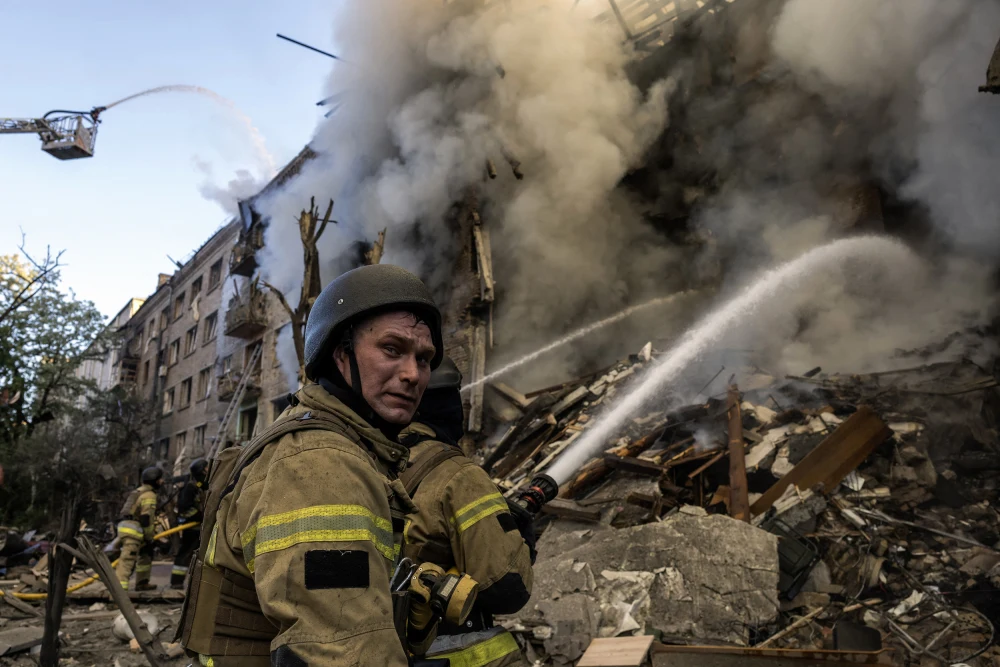
In an earlier post on Sunday morning, Zelenskyy urged foreign partners to further strengthen Ukraine’s air defenses, as long-range nightly Russian strikes continue. On Saturday night into Sunday morning, Russia launched 98 drones into Ukraine, according to the Ukrainian air force. Sixty-nine of the craft were shot down or suppressed.
“In parallel with the diplomatic track, we must do everything to strengthen our defense against such wicked Russian attacks,” Zelenskyy wrote. “It is extremely important to speed up the implementation of all our agreements with partners regarding air defense systems and missiles for them.”
The U.S.-proposed 28-point peace plan was drafted in coordination with the Kremlin and with input from Rustem Umerov, the secretary of Ukraine’s National Security and Defence Council.
The plan includes a number of maximalist demands that the Kremlin has long demanded and that have been previously dismissed as non-starters for Kyiv, including that Ukraine cut its armed forces by more than half and cede swaths of territory not yet occupied by Russia.
Ukraine would also be forbidden from possessing long-range weapons, while Moscow would retain virtually all the territory it has occupied — and receive some form of recognition of its 2014 seizure of Crimea under the latest proposed U.S. plan.
Russian President Vladimir Putin said during a meeting of his Security Council on Friday that the Kremlin had received the proposal. “I believe that it could also form the basis for a final peace settlement, but this text has not been discussed with us in detail,” Putin said.
“I believe the reason is the same: the U.S. administration has not yet managed to secure the agreement of the Ukrainian side, as Ukraine is opposed to it,” Putin added. “Apparently, Ukraine and its European allies are still under the illusion that they can inflict a strategic defeat on Russia on the battlefield.”
In an address to the nation on Friday, Zelenskyy said Ukraine is facing “one of the most difficult moments in our history” and that Ukraine in the coming days may have to choose between “dignity” or the “risk of losing a key partner,” meaning the U.S.
He promised to “work calmly” and quickly with the U.S. on the plan and to search for “constructive solutions.” He added, “I will present arguments, I will persuade, I will offer alternatives.”
On Saturday, a bipartisan group of senators said they were told by Rubio in a phone call that the 28-point plan was developed by Russia, not the U.S.
In a statement on social media Saturday evening, Rubio denied the senators’ claims, asserting “the peace proposal was authored by the U.S.”
Rubio did not directly respond to the senators’ characterization of his message to them.
Rubio described the proposal as “a strong framework for ongoing negotiations,” adding, “It is based on input from the Russian side. But it is also based on previous and ongoing input from Ukraine.”
In a statement, Republican Sen. Mike Rounds said the administration’s peace efforts are “relying on input from both Russia and Ukraine.”
Polish Prime Minister Donald Tusk expressed his skepticism of the proposed plan in a post to X on Sunday, in which he said the “leaders of Europe, Canada and Japan” had “declared our readiness to work on the 28-point plan despite some reservations.”
“However, before we start our work, it would be good to know for sure who is the author of the plan and where was it created,” Tusk said.
In an open letter sent to ABC News on Sunday, a group of 48 current and former officials and lawmakers from Europe and Ukraine wrote to Trump warning that “any appeasement of Russia” would be “morally reprehensible and an outrage against human decency.”
“Strong American leadership is the only hope,” the letter added. “A cowed America can never be great again, a cowed America can never be first. America is only great and first when it steadfastly stands for freedom, democracy, respect for human rights and rule of law.”
One of the signatories — Oleksandr Merezhko, a member of the Ukrainian parliament and the chair of the body’s foreign affairs committee — told ABC News that of all 28 points in the U.S.-proposed deal, only the clause confirming Ukraine’s sovereignty gave him reason for optimism.