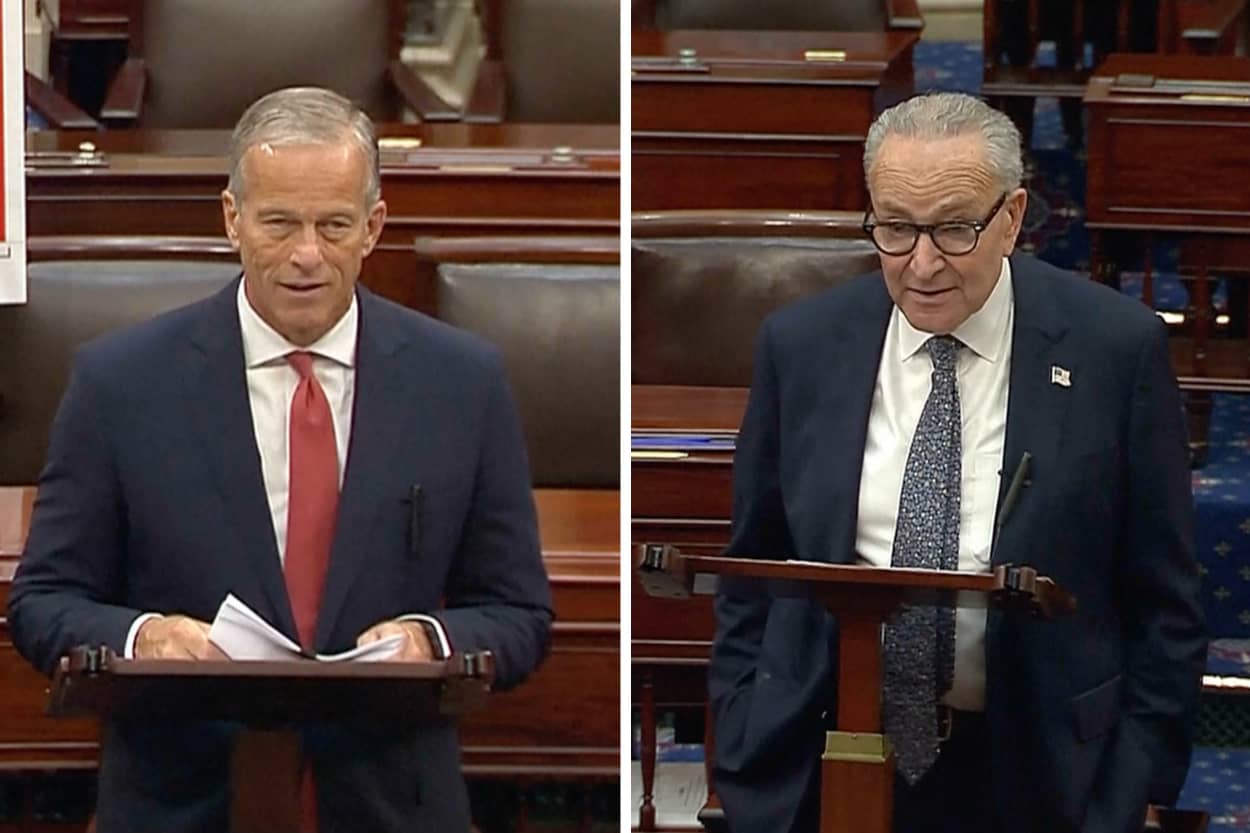
Now in its 38th day, the U.S. government shutdown is the longest in U.S. history.
Republican and Democratic lawmakers remain at a stalemate on finding a government funding solution. Meanwhile, the shutdown impacts are mounting. SNAP funding is at the center of a high-profile court battle and flights are delayed around the country amid air traffic controller shortages.
Emerging from a closed-door conference meeting, Republican senators on Friday were palpably angered by Democrats’ offer to allow government funding to advance if it included a one-year extension of the Affordable Care Act tax credits.
It’s clear that the offer, which Senate Minority Leader Chuck Schumer and Democrats made in a series of floor speeches earlier Friday, is going over like a lead balloon.
“A lousy, terrible, horrible idea,” Sen. Lindsey Graham, R-S.C., said departing that meeting. “We’re not going to continue for a year to load up insurance companies with taxpayer dollars to get an inferior outcome.”
“There’s just no way that the Democrats are coming out here and pounding their chest and playing tough guy,” Sen. Eric Schmitt, R-Mo., said. “It’s outrageous.”
So what’s next?
The Senate will be in session on Saturday, starting at noon but it’s not clear what, if anything, senators will vote on. At this point in time, there are no votes scheduled.
Earlier, Sen. Katie Britt, R-Ala., who sits on the appropriations committee, said Republicans were aiming to hold a vote on a short-term funding bill this weekend that would include the three full-year spending bills within it — if Democrats allow it advance.
Said Sen. Markwayne Mullin, R-Okla.: “I don’t know what we do this weekend, because we’ve got to have stuff to vote on. And either they give unanimous consent, or we go through this long, drawn out debate process.”
After the Senate adjourned Friday evening, some senators appeared to be preparing to depart D.C.
An appeals court has denied the Trump administration’s request to lift a judge’s order that it fully fund SNAP for November, as several states have already begun issuing benefits.
As of Friday evening, nine states said they had begun processing Supplemental Nutrition Assistance Program benefits: Kansas, Pennsylvania, Wisconsin, Vermont, New Jersey, Minnesota, Connecticut, New York and North Carolina.
The Senate failed to advance a bill Friday evening that would’ve paid federal workers who are actively working during the shutdown.
It would have needed 60 votes to advance. The measure, introduced by Sen. Ron Johnson, R-Wis., failed by a vote of 53-43.
Democratic Sens. Ben Ray Lujan, Jon Ossoff and Raphael Warnock voted with all Republicans to advance the bill. All other Democrats voted against it.
The Senate began voting Friday on a bill led by Sen. Ron Johnson, R-Wis., that aims to pay federal workers who are currently reporting to work amid the shutdown. The vote delayed due to well over an hour of floor debate.
The GOP speeches seemed partially inspired by frustration over the Democratic funding offer made earlier Friday. There was noticeable irritation among those who spoke on the need to end the shutdown and pay federal workers.
Johnson, in a speech ahead of the vote, urged Democrats to back his bill, which will need 60 votes to advance when it is finally called.
“Think about what your vote means to people that don’t want to be used as pawns,” Johnson said.
Johnson yielded time to Sen. Ted Cruz, R-Texas, who chairs the Senate Transportation Committee. Cruz, in his remarks, expressed the strain that the lack of pay for air traffic controllers is putting on those airlines and the flying public.
“Yesterday I had a conversation with the administrator of the FAA. It was chilling,” Cruz said.
“God, I hope it literally doesn’t take planes falling out of the sky,” Johnson said. “Tonight you can continue your shutdown or you can vote to pay the air traffic controllers so that is far less likely. If you vote no, and God forbid it actually happens, can you live with yourself?”
Ahead of the vote Sen. Gary Peters, D-Mich., gave a speech reiterating his concern that the bill “uses federal employees as pawns” and gives the administration too much discretion about how funds are used.
Still, the frustration was palpable.
“Are the Democrats deaf? Do they not hear from the people that they are putting in these situations? This is their shutdown!” Sen. Pete Ricketts, R-Neb., nearly screamed on the Senate floor.
At least six states say they have begun issuing November SNAP benefits as of Friday afternoon, despite the Trump administration actively fighting a court order requiring the government to fund the program.
Officials from California, Wisconsin, Kansas and Pennsylvania said that full SNAP benefits are already available to some recipients.
Additionally, New York Gov. Kathy Hochul said she has directed state agencies to issue full SNAP benefits for November. She said in a statement that New York SNAP recipients should be able to access their benefits by Sunday.
The source of these funds is not immediately clear. Kansas has already distributed more than $31.6 million to 86,000 households, and Wisconsin has distributed $104.4 million to 337,137 households, state officials said.
In a statement, New Jersey Gov. Phil Murphy said that his state “acted immediately” to process SNAP benefits after receiving funding from the USDA on Friday morning.
Vermont also has processed full SNAP benefits for November, according to state treasurer Mike Pieciak.