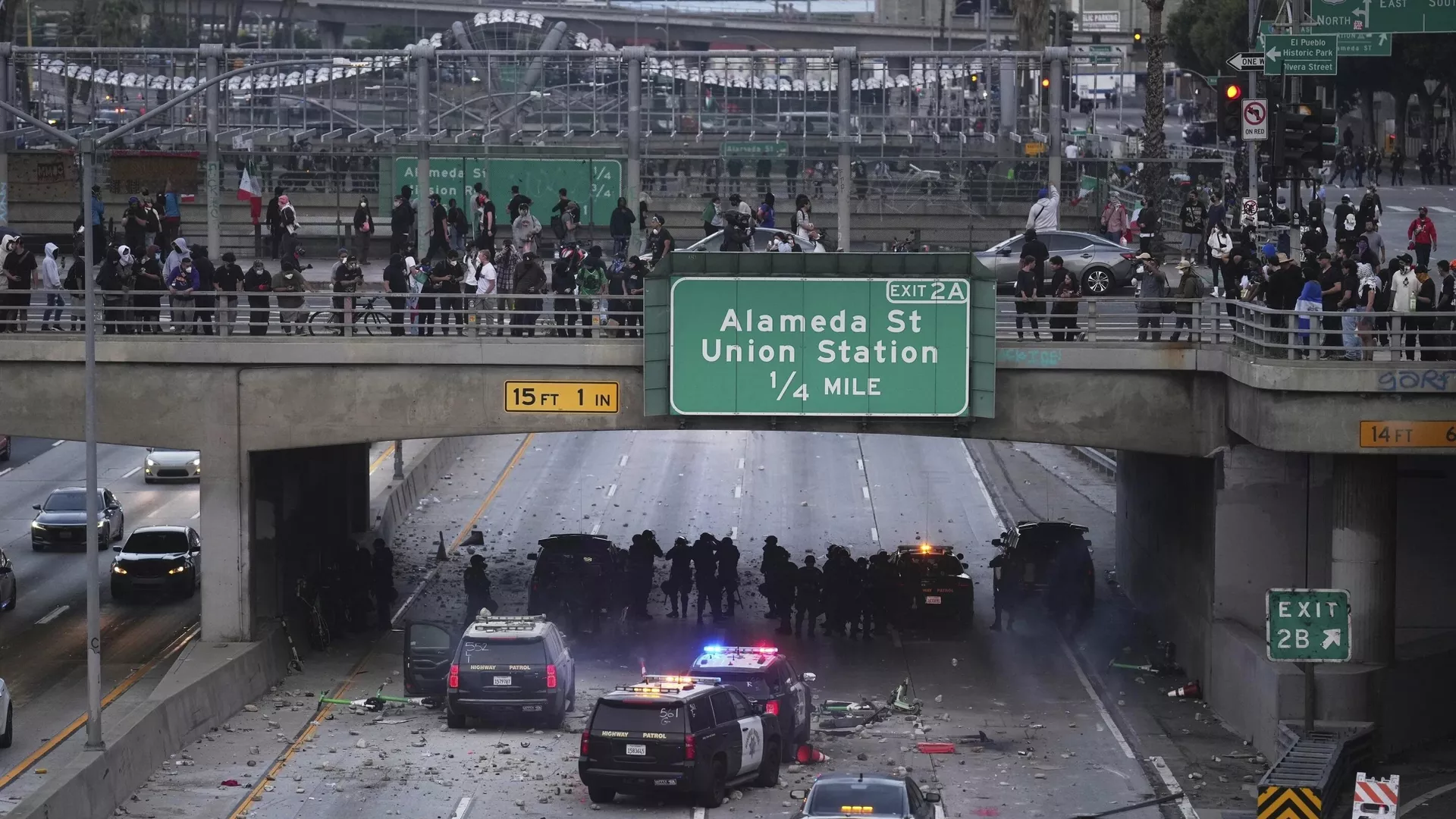
The protests in California have intensified since they began on June 6. The National Guard and Marines have been sent in to disperse the protesters, and a curfew has been imposed in parts of downtown Los Angeles. Chen Ping, a researcher at the Institute of Chinese Studies at Fudan University, said in an interview with the Russian Satellite News Agency that California is the “leader” in boycotting US President Trump. If Trump does not take advantage of this conflict to completely subdue California, then his victory in next year’s midterm elections will be uncertain.
On June 6, law enforcement officers from the U.S. Immigration and Customs Enforcement (ICE) and other federal agencies raided at least seven locations in Los Angeles, including shopping malls and factories, to capture illegal immigrants, arresting 44 people. Subsequently, ICE had serious conflicts with local community residents, and protests eventually broke out. U.S. President Trump posted on social media that the protests in Los Angeles were actually an “invasion and occupation” by illegal immigrants and criminals, and instructed the military to “end the riots.”
Why is the Trump administration attacking California so hard?
Chen Ping said that combating illegal immigration was one of Trump’s main promises during the election. “Trump’s main promises during the election were, first, to expel illegal immigrants, mainly from Latin America, and to build a border wall. Second, to bring manufacturing back to China and fight a trade war, a technology war, and a financial war with China, so that America can be great again. Third, to cut taxes for the rich and reduce the fiscal deficit, and to expand the military, we have to massively cut fiscal spending on social security, health care, and the poor.”
The Trump administration has chosen California as the key area for hunting down illegal immigrants . One of the reasons is that California is a state governed by Democrats, which is commonly known as a blue state. Experts point out the special feature of California: “In the South, where the Democratic Party is dominant, California is the leader in resisting Trump.”
Chen Ping said: “First, California has the largest number of illegal immigrants, and California’s agriculture and infrastructure are heavily dependent on illegal workers from Latin America. Second, California Governor Newsom is the most popular Democratic presidential candidate in the next term. He publicly advocates friendship with China and opposes Trump’s trade war against China, because California’s trade and the reconstruction of the Los Angeles fire are highly dependent on China’s supply chain. Third, California’s economy and high-tech are the strongest among all states in the United States. If California becomes independent, California’s GDP can enter the top 20 in the world.”
Experts say the handling of the conflict in California will affect the outcome of next year’s U.S. mid-term elections.
“If Trump does not take advantage of the conflict between Los Angeles residents and the National Guard to subdue California, Trump will have little hope of securing victory in next year’s midterm elections. Of course, Trump’s attempt to deprive state governments of their power to command local forces is a gamble. Not only may Democratic governors oppose it, but Republican governors may not really support it. This will have a more far-reaching impact on the division and chaos in the United States than Musk’s layoffs of federal government employees. Historically, only the civil rights movement of African Americans in the United States forced the president to use federal troops to subdue state governments that insisted on racial segregation.”
Policy conflict turns into constitutional crisis
The conflict between the U.S. federal government and the California government over immigration enforcement and military deployment continues to escalate, and the incident has evolved from a policy conflict to a constitutional crisis.
The White House sent 2,000 National Guard troops to Los Angeles without consulting the state government, a move that sparked a strong protest from California Governor Gavin Newsom. On June 8, Newsom made it clear that the federal government’s actions violated the Tenth Amendment to the Constitution , and signed an executive order requiring the Department of Defense to withdraw its troops.
The Tenth Amendment to the U.S. Constitution clearly states that powers not granted to the federal government belong to the states. However, the Trump administration cited the Insurrection Act as a legal basis, arguing that special powers can be exercised when “public safety is threatened.”
Chen Ping said that the U.S. constitutional system imposes four major constraints on the executive power of the U.S. president: the first is the separation of powers between the federal government and state governments; the second is that Congress restricts the president’s budgetary and executive powers; the third is the independent judgment of the Supreme Court; and the fourth is the independent monetary policy of the Federal Reserve.
California Governor Gavin Newsom wrote on the X platform on June 9: “I call on the Trump administration to revoke its illegal deployment of the National Guard to Los Angeles and return the command to me. We had no problem until Trump got involved.” He has filed a lawsuit against the Trump administration. Judicial records show that this is the first time since the Los Angeles riots in 1992 that the U.S. federal government has deployed the National Guard on a large scale without the consent of the state government. The California Attorney General’s Office pointed out in the lawsuit filed with the U.S. Ninth Circuit Court on June 9 that the federal action caused direct economic losses of about $38 million to the local area.
Following the riots caused by the Immigration and Customs Enforcement raid in Los Angeles, protests are still spreading and escalating in some other cities in the United States. Protests against the government’s immigration policies have spread from Los Angeles, California to at least 24 cities in the United States, including New York, San Francisco, Dallas and Austin.